Iran Warns of Bab al-Mandab Closure Amid Trump Ultimatum
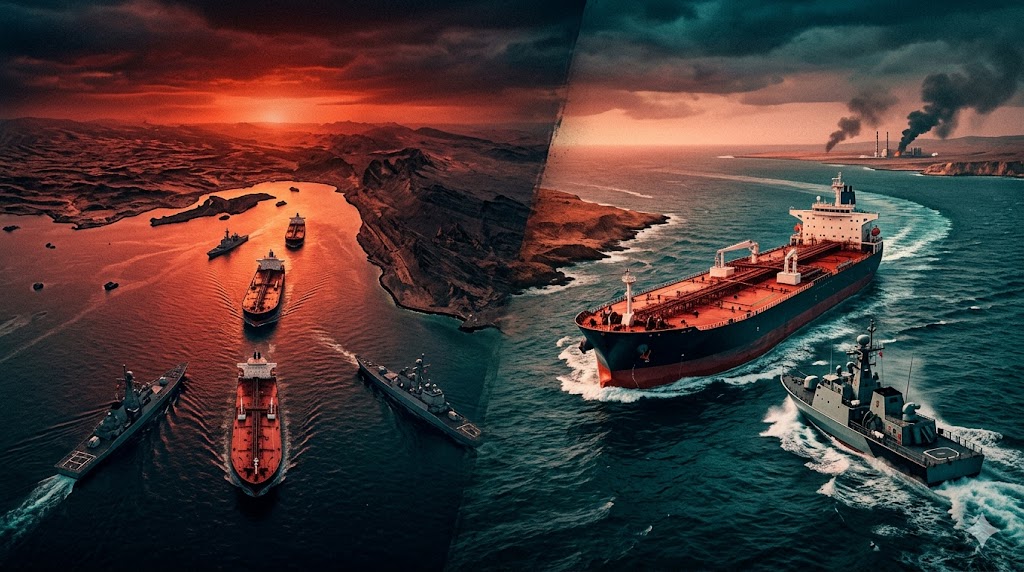
Tensions in the Middle East have reached a dangerous new peak. As the United States and Iran edge closer to full-scale confrontation, a senior Iranian advisor has issued a stark warning that could reshape global trade overnight. Ali Akbar Velayati, a top counselor to Iran’s Supreme Leader Mojtaba Khamenei, declared that the “Resistance front” now views the Bab al-Mandab Strait with the same strategic weight as the already-blockaded Strait of Hormuz. The message, delivered in English on social media, came just hours after President Donald Trump’s latest ultimatum demanding Iran reopen the Strait of Hormuz or face devastating consequences.
This latest Iran Bab al-Mandab threat is no idle rhetoric. It directly responds to Trump’s repeated warnings and signals Tehran’s willingness to weaponize not one but two critical chokepoints in global maritime routes. With the Strait of Hormuz effectively closed since late February 2026 amid the ongoing US-Israel war on Iran, any further disruption through Bab al-Mandab could trigger an unprecedented global economic crisis. Oil prices have already surged, shipping lanes are in chaos, and tanker warnings are multiplying. The world is watching to see if Tuesday’s deadline becomes the spark for wider conflict.
Background: How the Strait of Hormuz Crisis Unfolded
To understand the gravity of the current Iran Strait of Hormuz warning, it is essential to revisit the timeline. On February 28, 2026, US and Israeli strikes targeted Iranian military and nuclear sites. In retaliation, Iran’s Islamic Revolutionary Guard Corps (IRGC) Navy declared the Strait of Hormuz off-limits to unauthorized vessels. Navigation warnings were broadcast via VHF radio, turning what had been a vital artery for 20% of the world’s oil supply into a no-go zone for most commercial traffic.
The closure was immediate and operational. Tankers attempting passage without explicit Iranian approval were turned back or faced explicit threats. This Iran naval warning ships and tankers disrupted supply chains that had operated smoothly for decades. Oil exporters in the Persian Gulf found themselves isolated, forcing rerouting through already congested alternatives. The result? Brent crude prices climbed past $109 per barrel, with analysts warning of spikes to $120–$200 if the blockade persists.
President Trump has not minced words in response. In a series of strongly worded statements, including an expletive-laden post on Easter Sunday, he set a firm deadline: reopen the Strait of Hormuz by Tuesday or prepare for “Power Plant Day and Bridge Day” in Iran. “Open the Strait, you crazy bastards, or you’ll be living in Hell – JUST WATCH,” Trump declared. This presidential warning statement underscores Washington’s determination to restore freedom of navigation, but it has only hardened Tehran’s resolve.
Velayati’s Warning: Bab al-Mandab as the Next Target
The latest escalation arrived swiftly. In his April 5, 2026, post, Velayati made clear that Iran’s unified command of the Resistance front — which includes allies such as the Houthis in Yemen — sees Bab al-Mandab as interchangeable with Hormuz in strategic terms. “If the White House dares to repeat its foolish mistakes, it will soon realize that the flow of global energy and trade can be disrupted with a single move,” he wrote.
This Iran Bab al-Mandab threat is particularly alarming because the strait does not even border Iran directly. It lies between Yemen and the Horn of Africa, serving as the gateway from the Red Sea to the Gulf of Aden and, ultimately, the Suez Canal. Iran’s influence over the Houthis gives it plausible deniability while maintaining credible leverage. Previous Houthi attacks on Red Sea shipping during the Gaza conflict demonstrated how easily this route can be disrupted. Now, with the broader Iran-Israel war intensifying, the risk of coordinated action has multiplied.
Iranian officials have echoed the sentiment. Parliamentary Speaker Mohammad Bagher Ghalibaf and unnamed military sources have hinted at expanding “insecurity” to other straits if the US or Israel strikes additional Iranian infrastructure, such as Kharg Island. The message is unmistakable: any attempt to force open the Strait of Hormuz by military means could trigger a second closure, creating a dual-chokepoint nightmare for global commerce.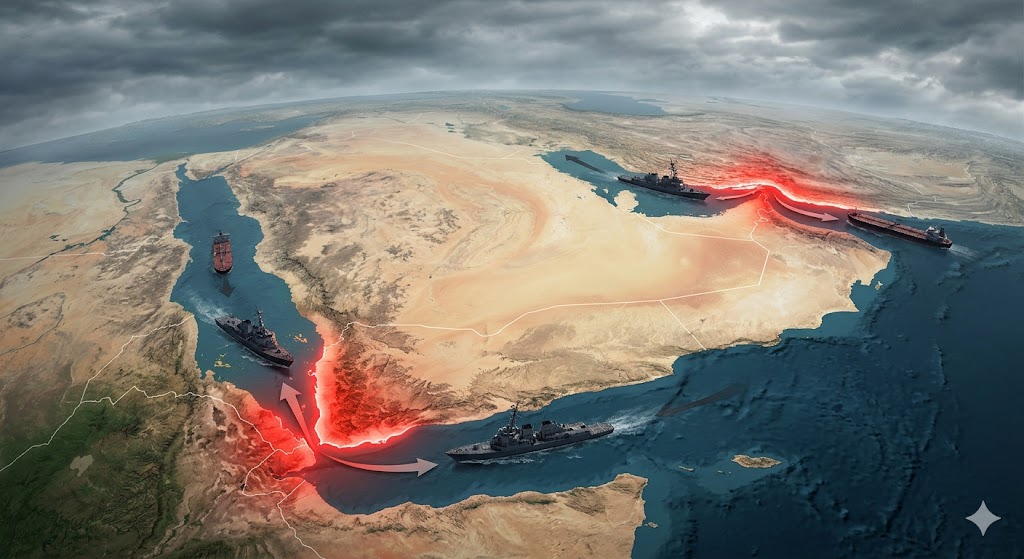
The Strait of Hormuz is glowing with a red tension effect at the top right, while the Bab al-Mandab Strait at the southern entrance of the Red Sea is also highlighted in red. The visualization clearly shows how these two specific chokepoints control the flow of massive global shipping lanes.
Strategic Importance of These Global Waterways
The Strait of Hormuz and Bab al-Mandab Strait together handle an enormous share of world trade. The Strait of Hormuz, at its narrowest just 21 miles wide, has historically carried about 21 million barrels of oil per day — roughly one-fifth of global petroleum liquids and significant volumes of liquefied natural gas. Its closure has already forced rerouting and driven up insurance premiums for tankers.
Bab al-Mandab is narrower still at points and serves as the southern entrance to the Red Sea. Approximately 12% of global maritime trade passes through it annually, including 4.1 to 4.8 million barrels of oil daily. Container ships, bulk carriers, and tankers bound for Europe via the Suez Canal depend on this route. A simultaneous blockade would isolate markets, spike freight rates, and compound the energy shock already underway.
These are not abstract figures. Manufacturers worldwide are bracing for higher costs of plastics, fertilizers, and transportation fuels. JPMorgan analysts have projected oil could reach $150–$200 per barrel under worst-case dual-closure scenarios. US gasoline prices have already climbed above $4 per gallon in many areas, and prolonged disruption risks stagflationary pressures across developed economies.
Economic Fallout: A Global Crisis in the Making
The Iran war escalation is already reshaping markets. With the Strait of Hormuz closed, alternative pipelines and overland routes cannot compensate for lost volumes. Saudi Arabia has increased shipments via its Yanbu port on the Red Sea, but those tankers must still navigate Bab al-Mandab — now under implicit threat.
Shipping companies have issued fresh tanker warnings and rerouted vessels around the Cape of Good Hope, adding thousands of miles and weeks to journeys. Insurance costs have soared. Emerging economies in Asia, heavily dependent on Gulf oil, face the greatest risk of shortages and inflation. European nations reliant on Suez Canal traffic could see supply-chain breakdowns in consumer goods and energy.
Defense Secretary Pete Hegseth has described the coming days as “decisive,” signaling that the US military is prepared for sustained operations to protect sea lanes. Yet analysts caution that kinetic action to reopen the Strait of Hormuz could provoke exactly the Bab al-Mandab response Velayati described, turning a regional conflict into a worldwide economic emergency.
US Posture, Hegseth’s Role, and Israeli Coordination
The Trump administration’s approach combines tough public rhetoric with behind-the-scenes diplomacy. Hegseth, as Defense Secretary, has overseen personnel changes and operational planning while issuing clear warnings to Tehran. US Central Command has emphasized freedom of navigation as a core national interest, even as it coordinates with allies to deter further Iranian moves.
Israel, already engaged in direct exchanges with Iran, views the maritime threats as existential. Iranian-backed groups have launched missiles toward Israeli targets, and the possibility of expanded naval operations raises the specter of a multi-front war. The Iran Israel war dimension adds urgency: any closure of Bab al-Mandab would not only hurt global trade but also isolate Israeli shipping routes.
Shipping Alerts, Tanker Warnings, and Maritime Reality
Maritime authorities have issued repeated Iran shipping alerts. The IRGC Navy continues to broadcast prohibitions on unauthorized passage through the Strait of Hormuz. Tanker operators report heightened risk assessments, with many vessels now avoiding the Persian Gulf entirely. European Union and UK maritime trade operations have acknowledged the new reality, advising caution in the Red Sea as well.
If Velayati’s warning materializes, the Bab al-Mandab Strait could see similar navigational denial tactics — mines, drone swarms, or Houthi missile strikes. The cumulative effect would be a near-total shutdown of two of the world’s most important energy corridors, with ripple effects lasting months even after any resolution.
Historical Context and Iran’s Long-Standing Strategy
Iran has long regarded control of the Strait of Hormuz as a core deterrent. Threats to close it date back decades, but the current enforcement marks the first sustained operational closure in modern history. Tehran’s strategy leverages geography: narrow straits favor the defender, and asymmetric naval capabilities — speedboats, drones, and anti-ship missiles — allow a weaker navy to challenge superpowers.
The Bab al-Mandab expansion fits this playbook. By signaling readiness to involve the Resistance axis, Iran aims to deter US strikes on its homeland while raising the cost of continued pressure. The Iran foreign minister and other officials have reinforced this narrative in public statements, framing any US action as reckless adventurism that endangers the entire global economy.
International Reactions and Diplomatic Horizons
World leaders have expressed alarm. European nations dependent on Gulf energy have urged de-escalation. China and India, major importers of Iranian and Gulf oil, quietly press for restraint while diversifying supplies. The United Nations has called for dialogue, though veto powers limit meaningful action.
Some analysts see a narrow window for negotiation before Tuesday’s deadline. Others warn that domestic politics in both Washington and Tehran make compromise difficult. The presidential warning statement from Trump leaves little room for perceived weakness, while Iran’s leadership appears unified in its defiance.
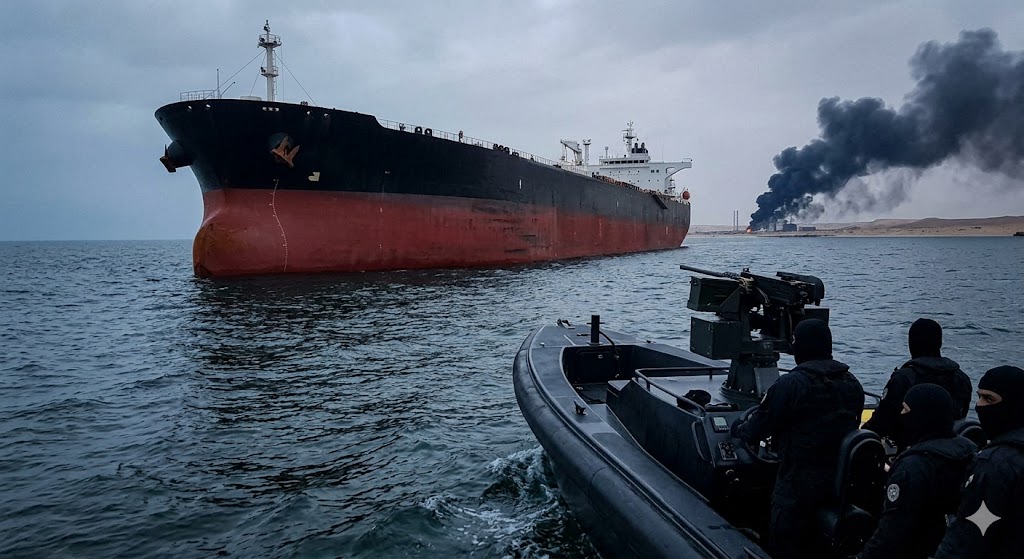
A large, generic VLCC (Very Large Crude Carrier) oil tanker, heavily loaded, is shown halted on a choppy, dark sea. It is being intercepted by an unmarked, fast-attack military vessel of the type used for asymmetric coastal enforcement.
Outlook: War, Crisis, or Fragile Peace?
The coming 48 hours are critical. If Iran does not reopen the Strait of Hormuz by the US deadline, military options may be exercised. Yet the Bab al-Mandab threat ensures that any escalation carries catastrophic global consequences. A dual closure could shave percentage points off worldwide GDP growth, ignite inflation, and destabilize fragile post-pandemic recoveries.
For now, the world holds its breath. Tanker captains scan the horizon for new warnings. Traders watch oil futures with unease. And diplomats work frantically behind the scenes to prevent the Iran war from becoming the spark for a broader economic catastrophe.
One thing is certain: the Iran Bab al-Mandab threat has transformed a regional dispute into a global concern. Whether Tuesday brings resolution or further escalation will shape energy markets, shipping routes, and international security for years to come.