Iran Israel US War: 45-Day Ceasefire Proposal Explained
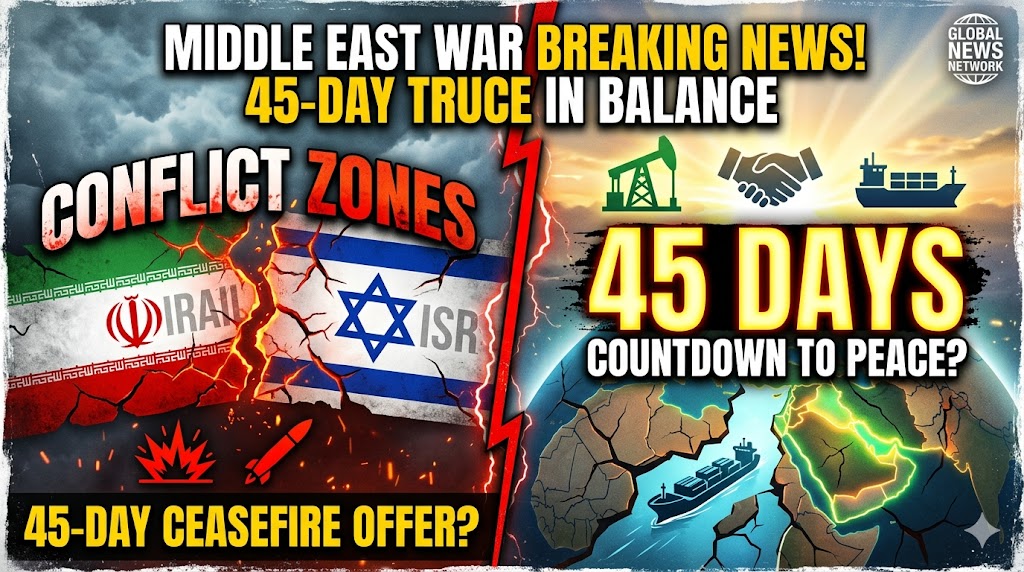
The Brink of De-escalation: Global Mediators Push for 45-Day Iran Ceasefire
As of 6 April 2026, the world stands at a critical juncture. The military confrontation between Iran, Israel, and the United States, which ignited in late February, has reached a point of systemic exhaustion. With the Strait of Hormuz functionally impaired and civilian infrastructure in Tehran and Haifa under fire, a high-stakes diplomatic effort is underway. International mediators, led by China, Russia, and France, along with regional actors like Pakistan, Egypt, and Turkey, are urgently calling for a 45-day ceasefire to prevent a total regional collapse.
This article delves into the current situation, the strict conditions set by Tehran, and why this 45-day window is being hailed as the last chance for peace.
The 6 April Situation: A Region Under Fire
The dawn of 6 April 2026 brought fresh reports of escalations. The Israeli Defense Forces (IDF) confirmed a wave of strikes targeting regime assets in Tehran, including areas near Sharif University. Simultaneously, Iranian missile strikes have impacted residential sectors in Haifa, leading to a grim cycle of retaliation.
The human and structural cost has become unsustainable. The war is no longer a localized conflict; it has evolved into a global economic crisis.
Infrastructure Damage: Key energy facilities, water desalination plants, and educational institutions have been hit.
Economic Paralysis: The closure of the Strait of Hormuz has throttled 20% of the world’s oil and gas supply, sending Brent crude prices soaring toward $150 per barrel.
Regional Suffering: Gulf countries and Middle East Asian nations are facing asymmetric economic shocks, with disrupted supply chains affecting everything from fertilizer access in India to semiconductor manufacturing in East Asia.
The 45-Day Ceasefire Proposal: A Two-Phase Roadmap
Mediators have presented a structured 45-day ceasefire plan to the U.S. State Department and the Iranian Foreign Ministry. The proposal, widely reported by sources such as Axios, suggests a two-phased approach to ending the hostilities.
Phase 1: Immediate Cessation of Hostilities
For a period of 45 days, all parties—including the U.S. Navy, the IDF, and the Islamic Revolutionary Guard Corps (IRGC)—would freeze military operations. This period is designed to facilitate:
The reopening of the Strait of Hormuz for commercial shipping.
The delivery of humanitarian aid to affected civilian zones.
Confidence-building measures (CBMs) between Washington and Tehran.
Phase 2: Permanent Peace Negotiations
If the 45-day truce holds, the second phase involves negotiating a permanent end to the war. This would include long-term maritime security agreements and a framework for regional stability that involves Israel.
Iran’s Strict Conditions and the US Response
The Iran ceasefire conditions remain the primary hurdle. Iranian Foreign Minister Abbas Araghchi has communicated through mediators that Tehran will not accept a paper-only truce.
The Gaza-Style Fear
Iran has explicitly stated it rejects any ceasefire that allows the U.S. or Israel to resume strikes at will. Their demands include:
1. Guaranteed Non-Aggression: A formal commitment that civilian and energy infrastructure will not be targeted during or after the talks.
2. Lifting of Specific Sanctions: Immediate relief on insurance and shipping restrictions to allow the flow of Iranian energy.
3. Security Guarantees: Iran seeks a security corridor that ensures its regional leverage is not dismantled during the negotiation phase.
On the other side, U.S. President Donald Trump has maintained a dual-track strategy. While his administration is engaged in text-based negotiations via special envoy Steve Witkoff, Trump has also set a firm deadline. He has signaled that if the Strait of Hormuz is not reopened by Tuesday evening, a massive bombing campaign against Iranian energy facilities is ready to go.
The Role of Global Mediators: China, Russia, and France
The international community is no longer standing on the sidelines. China and Russia have played a pivotal role in the UN Security Council, recently vetoing resolutions that authorized purely military solutions to reopen the Strait.
Chinese Foreign Minister Wang Yi has emphasized that a political settlement is the only viable path. Beijing’s interest is clear: as a massive importer of Gulf energy, the continued war threatens China's internal economic stability. Similarly, France has labeled military intervention as unrealistic, urging the U.S. to focus on the 45-day diplomatic window instead of a kinetic escalation.
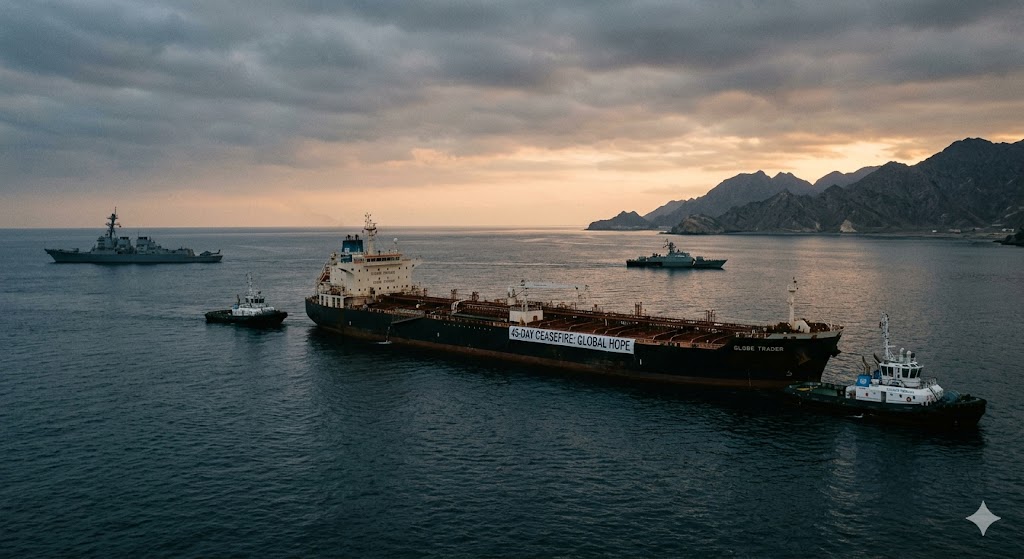
A banner on the cargo ship reads '45-DAY CEASEFIRE: GLOBAL HOPE,' symbolizing the proposed diplomatic window to stabilize energy markets and regional tensions between the United States, Iran, and Israel.
The Global and Regional Impact
The Iran-Israel-US war has created a ripple effect that touches every corner of the globe.
Sector | Impact of the Conflict
Global Energy | Oil prices hitting record highs; gas outages reported in parts of Asia and Europe.
Agriculture | Fertilizer shortages in India and Brazil due to Gulf supply chain breaks.
Maritime Trade | Insurance premiums for the Persian Gulf have become prohibitively expensive.
Regional Stability | Gulf states like Bahrain and Qatar face immense pressure as their waters become a combat zone.
The consensus among mediators is that the 6 April push for a ceasefire is not just about saving lives in Tehran or Haifa—it is about preventing a global depression.
Conclusion: A Final Opportunity for Peace
The next 48 hours are arguably the most significant in modern Middle Eastern history. The 45-day ceasefire offers a much-needed off-ramp for all involved parties. For the United States and Israel, it is a chance to stabilize global markets and secure maritime routes. For Iran, it is an opportunity to protect its national infrastructure from massive destruction.
As mediators speak to ministers today, the world waits to see if diplomacy can finally silence the drums of war. The last date for a decision is approaching, and the cost of failure is a catastrophe that no nation can afford.