China- Russia Forge Unified Front to Halt Global US-Iran War
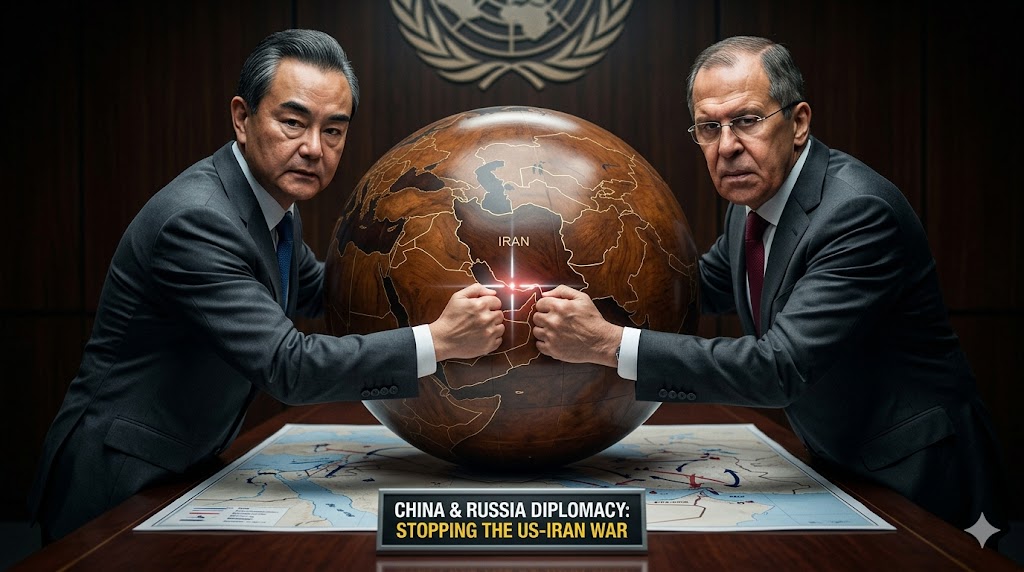
The diplomatic landscape of 2026 has been fundamentally reshaped by a pivotal phone conversation held on April 5, 2026, between Chinese Foreign Minister Wang Yi and Russian Foreign Minister Sergey Lavrov. This high-level discussion addressed the rapidly deteriorating security situation in the Middle East, specifically the escalating US-Iran war that has now threatened to become a global conflagration. Despite their historically different roles in the global order—where China has often acted as a pragmatic economic partner to the United States and Russia has remained its primary strategic adversary—the two nations have found a common cause in demanding an immediate end to hostilities.
The April 5th discussions focused heavily on the paralyzed state of the Strait of Hormuz, a waterway responsible for nearly 25 percent of global oil trade and 20 percent of liquefied natural gas. For China, the stakes are existential, as roughly 45 percent of its oil imports transit through this narrow passage. Wang Yi emphasized during the call that the fundamental way to resolve the navigation crisis is not through further military escalation but through an immediate ceasefire. He called for an objective and balanced approach from the international community, urging a return to the political track. Sergey Lavrov echoed these sentiments, labeling the ongoing US-Israeli military operations as unprovoked aggression and calling for an immediate cessation of all military actions to prevent a total regional collapse.
To understand the weight of this 2026 alliance, one must look at the long and often turbulent history of China-Russia relations. The relationship traces back to the 17th century with the Treaty of Nerchinsk, but the modern foundation was laid in 1949 with the establishment of the People's Republic of China. Initially, the Soviet Union and China were close ideological allies, but the 1960s saw the infamous Sino-Soviet split. Ideological differences and border disputes led to a brief but bloody conflict in 1969.
Following the dissolution of the Soviet Union in 1991, relations began a slow but steady repair. Throughout the 1990s and 2000s, both nations realized that their mutual desire for a multipolar world outweighed their past grievances. The signing of the Treaty of Good-Neighborliness and Friendly Cooperation in 2001 marked a turning point, formalizing a strategic partnership that has only deepened in the face of perceived Western overreach. Today, this history of rivalry has been replaced by a comprehensive strategic partnership of coordination for a new era. This historical evolution explains why, in 2026, they are able to act as a unified force against what they perceive as Western destabilization.
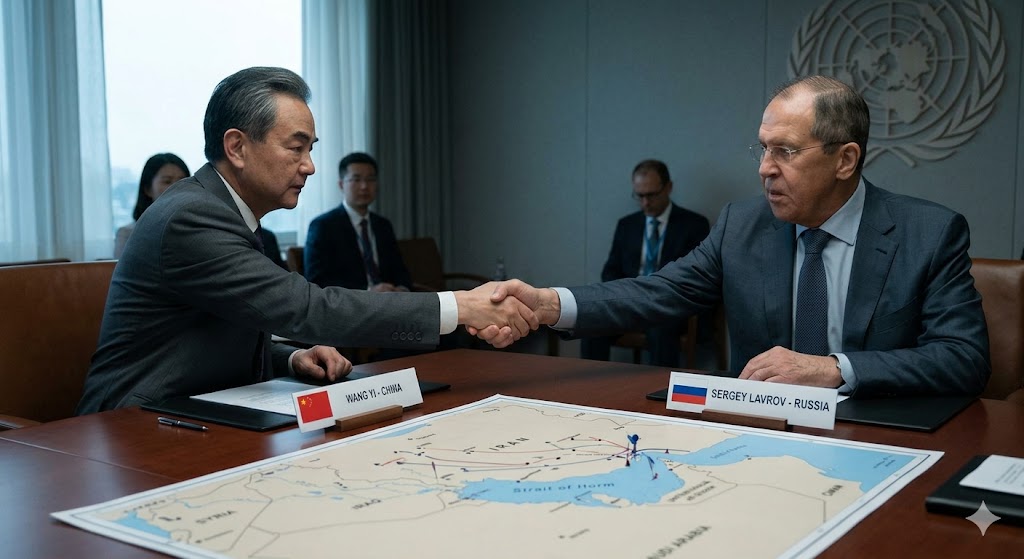 A critical moment during the April 5, 2026, call between Chinese Foreign Minister Wang Yi and Russian Foreign Minister Sergey Lavrov, as they forge a joint diplomatic front over a marked map of the Strait of Hormuz, demanding an immediate ceasefire in the US-Iran war and outlining their shared responsibility to prevent global conflict.
Current Situation and the 2026 Conflict
The 2026 conflict began on February 28 with a series of US and Israeli strikes against Iranian targets, triggering a rapid escalation that has drawn in regional proxies and shuttered international shipping. As of April 2026, the Strait of Hormuz remains effectively closed, causing global energy prices to soar. This situation has forced China and Russia to step out of their respective shells. While China has historically been a supporter of global trade systems often led by America, its role has shifted toward a mediator that emphasizes sovereignty over intervention.
Russia, on the other hand, has utilized the conflict to highlight what it calls the failure of the US-led international order. By standing together, they are presenting a dual-engine diplomatic front. They are not merely allies of Iran; they are acting as the primary counterbalance to the US-Israeli coalition. This current situation has accelerated their transition from strategic partners to what many analysts now describe as a de facto military and political bloc, though both nations still officially avoid the term alliance to maintain diplomatic flexibility.
Security Council Membership and Global Responsibilities
As permanent members of the United Nations Security Council (UNSC), China and Russia have unique legal and moral responsibilities to maintain international peace. During their April 5th call, Wang Yi and Sergey Lavrov discussed the upcoming vote on a Bahraini-drafted resolution regarding the protection of commercial shipping. They agreed that any resolution must not be used as a pretext for unauthorized military operations.
Their behavior in the Security Council reflects a shared philosophy of non-intervention. By using their veto power and diplomatic influence, they are attempting to steer the international community away from a military solution. They argue that the UN's role should be to facilitate dialogue, not to provide a legal cover for strikes on sovereign nations. This stance has garnered support from many countries in the Global South, who view the Russo-Chinese position as a safeguard against unilateral Western power.
Strategic Neutrality and Humanitarian Aid
While both nations are behaving as neutral mediators within the framework of the UN, their actions on the ground tell a more nuanced story. China and Russia have become the primary providers of humanitarian aid to Iran and other Middle Eastern countries suffering from the fallout of the war. Since late March 2026, massive shipments of food and medicine have arrived at Iranian borders.
As US-led military strikes and sanctions impact local populations, Beijing and Moscow have coordinated:
1. Medical and Food Supplies: Over 300 metric tons of medicine and 150 metric tons of food were delivered by Russia in the last week of March alone.
2. Economic Stabilization: China has continued to engage in trade that bypasses US financial systems, providing a financial lifeline to regional economies.
3. Diplomatic Protection: By blocking UNSC resolutions that would intensify the conflict, they provide the political space necessary for a ceasefire to be discussed.
The Unlikely Alliance: China, Russia, and the US Factor
The current geopolitical climate presents a fascinating paradox. Historically, China has been a significant partner of America in terms of trade, holding hundreds of billions in US debt. Conversely, Russia has long been viewed as the primary enemy of the US. However, the 2026 war has forced these two giants into a partnership of necessity.
For China, the war threatens the Belt and Road Initiative and its massive energy imports. For Russia, the conflict provides an opportunity to assert itself as a global peacemaker and challenge Western hegemony. Together, they are behaving as responsible UNSC members, filling the vacuum left by a polarized West. They are not merely allies in the traditional sense; they are a combined force acting to preserve a world order where no single power can dictate terms to others.
Future Outlook: Friends, Allies, or Enemies?
The question remains: will this wartime cooperation lead to a permanent bond? In the immediate future, Russia and China will likely move from being strategic partners to formal allies. The 2026 war has proven to both nations that their security is intertwined. While economic competition may create friction in the long run, the current necessity of countering US military influence will keep them united.
Expect to see more joint naval drills, such as the Maritime Security Belt 2026, and a shared alternative financial system using the Yuan to bypass Western sanctions. The 2026 conflict may be remembered as the moment the world shifted from a US-led order to a definitive Russo-Chinese bloc.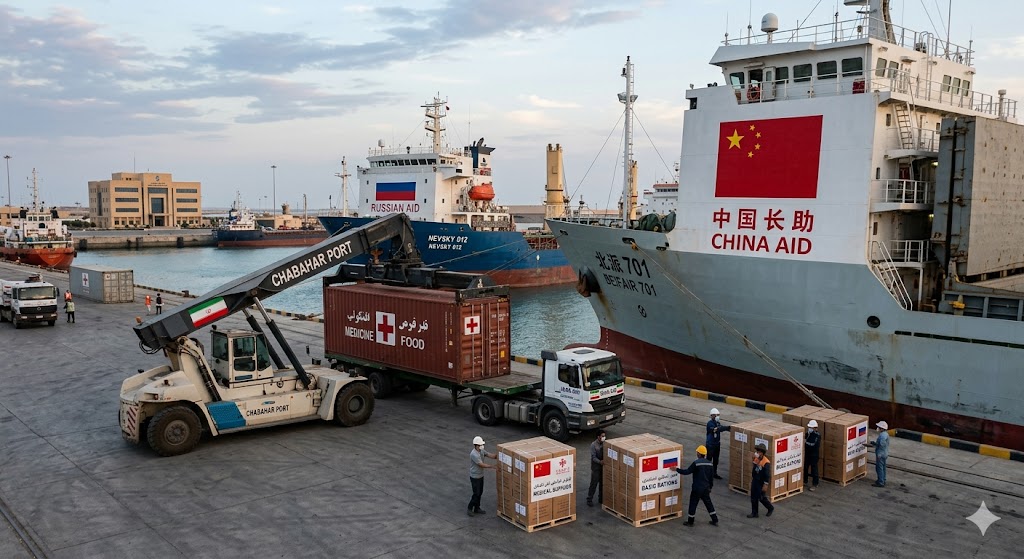
A documentary photograph from the port of Chabahar, Iran, showing the efficient unloading of coordinated Chinese and Russian cargo ships. Port workers and cranes move pallets of medical and food supplies labeled 'MEDICINE' and 'FOOD' and marked with 'CHINA AID' and 'RUSSIAN AID' logos, illustrating the strategic, neutral support and humanitarian lifeline Beijing and Moscow are providing to the Middle East despite the ongoing conflict.
Conclusion: A New Era of Diplomacy
The April 5, 2026, discussions between Wang Yi and Sergey Lavrov mark the beginning of a new era in international diplomacy. Their joint effort to stop the war and their coordinated humanitarian response suggest a growing convergence of interests between Beijing and Moscow. For a world on the brink, this diplomatic intervention may be the only thing standing between the current hostilities and a total global war.
The world now watches the UN Security Council as the joint force of China and Russia attempts to bring the US and Iran to the table. By emphasizing dialogue over destruction, they are fulfilling their responsibilities as global leaders while simultaneously reshaping the geopolitical map for the 21st century.