The United Nations History & Relevance: 2026 Perspective
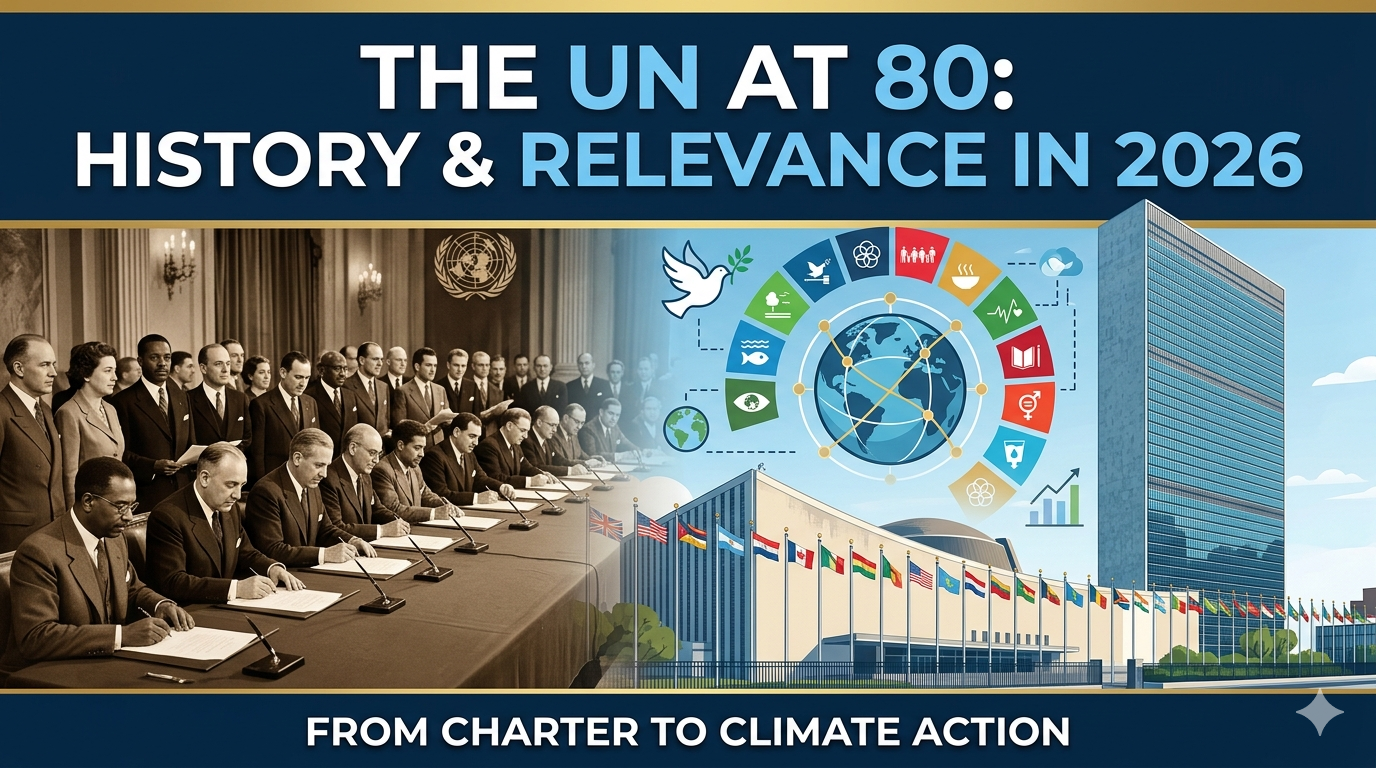
The Indispensable Global Architecture
The United Nations history is not merely a record of diplom
The Modern Mandate.
This 2026 photograph captures the evolving nature of UN relevance. Far from static bureaucracy, the UN is now a vital driver of digital governance and climate adaptation. These professionals are deploying drone technology for water management (SDG 6) and green energy solutions near a modernized UN headquarters, demonstrating the practical application of 21st-century multilateralism.
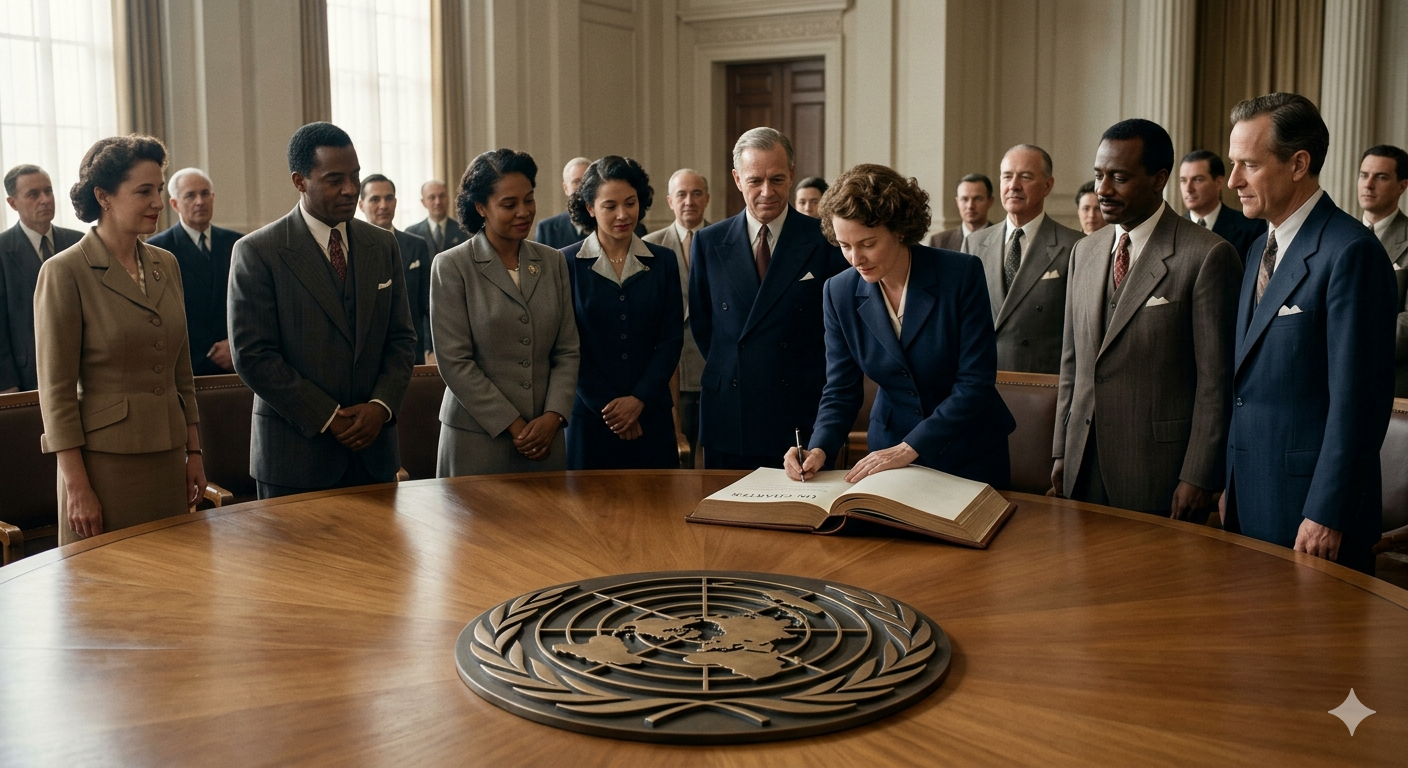
The Promise of Peace.
This image visually reconstructs the seminal 1945 signing of the United Nations Charter in San Francisco. Representatives from 50 nations gathered to create a rules-based international order, designed specifically to "save succeeding generations from the scourge of war."
The Indispensable Global Architecture
The United Nations history is not merely a record of diplomatic meetings and signed treaties; it is the narrative of humanity’s collective attempt to transcend its own destructive impulses. As we stand in 2026, the United Nations history serves as both a reminder of past horrors and a blueprint for future survival. Born from the ashes of a world scorched by total war, the UN has evolved from a 50-nation experiment into a 193-member cornerstone of global governance.
To understand United Nations history is to understand the shift from "might makes right" to a rules-based international order. In today’s world, characterized by rapid technological shifts, climate instability, and geopolitical realignment, the United Nations history provides the essential context for why this institution remains the only platform capable of addressing "problems without passports." This article explores the deep roots of the UN, its structural evolution, its monumental successes, and its undeniable relevance in the mid-2020s.
I. The Genesis: United Nations History and the Path to San Francisco
The United Nations history began long before the formal signing of its Charter. It was a reaction to the catastrophic failure of the League of Nations, which proved unable to prevent the rise of fascism and the subsequent outbreak of World War II.
The League of Nations’ Shadow
The first chapter of United Nations history is often written in the ink of the League’s shortcomings. Established after World War I, the League lacked an enforcement mechanism and was crippled by the absence of the United States. When the world spiraled toward war in the 1930s, the League was a bystander. The architects of the UN—Franklin D. Roosevelt and Winston Churchill—vowed not to repeat these mistakes.
The Atlantic Charter and the Declaration
In August 1941, the United Nations history took a formal turn on the HMS Prince of Wales. The Atlantic Charter established goals for the post-war world: no territorial aggrandizement, self-determination, and global cooperation. By January 1, 1942, the term "United Nations" was officially coined in a declaration signed by 26 nations pledging to continue the fight against the Axis powers.
Dumbarton Oaks and Yalta
The technical framework of the United Nations history was hammered out in 1944 at Dumbarton Oaks in Washington, D.C. Here, the "Big Four" (China, the Soviet Union, the UK, and the USA) debated the composition of the Security Council. The subsequent Yalta Conference in 1945 settled the thorny issue of the "veto power," a defining and controversial feature of United Nations history that persists today.
The 1945 San Francisco Conference
The climax of early United Nations history occurred between April and June 1945. Delegates from 50 nations gathered to finalize the UN Charter. Despite the immense diversity of political ideologies, the collective trauma of the war spurred a consensus. On October 24, 1945, the Charter was ratified, and the United Nations history officially began its operational phase.
II. The Structural Pillars of the UN
To appreciate United Nations history, one must examine the machinery that keeps the global engine running. The Charter established six primary organs, each with a specific mandate.
1. The General Assembly (GA)
The GA is the "parliament of nations." In the context of United Nations history, the GA has been the site of some of the world's most dramatic diplomatic moments. It is the only body where every member state has one vote, ensuring that the smallest Pacific island nation has the same floor time as a global superpower.
2. The Security Council (UNSC)
The UNSC is the most powerful organ in United Nations history. It has the authority to impose sanctions, authorize military action, and establish peacekeeping missions. The "P5"—the US, UK, France, Russia, and China—hold permanent seats and veto power, a structure that reflects the power dynamics of 1945 but remains a point of intense debate in 2026.
3. The Economic and Social Council (ECOSOC)
Often overlooked in casual discussions of United Nations history, ECOSOC manages the specialized agencies that impact daily life: the WHO, IMF, and World Bank. It is the heart of the UN’s development and humanitarian efforts.
4. The Secretariat
Led by the Secretary-General, the Secretariat is the UN's executive arm. Throughout United Nations history, the Secretary-General has acted as a "secular pope," using "good offices" to mediate conflicts and advocate for the world’s most vulnerable.
5. The International Court of Justice (ICJ)
Located in The Hague, the ICJ settles legal disputes between states. Its role in United Nations history has expanded significantly, recently presiding over landmark cases regarding genocide and maritime boundaries.
6. The Trusteeship Council
Originally designed to manage territories transitioning from colonial rule to independence, its mission was completed in 1994 with the independence of Palau. It remains a testament to the decolonization chapter of United Nations history.
III. The Cold War Era: Survival and Expansion
A significant portion of United Nations history was defined by the paralysis of the Cold War. The rivalry between the US and the USSR often neutralized the Security Council, but the UN found other ways to remain relevant.
The Invention of Peacekeeping
In 1948, the UN launched its first mission to monitor the Arab-Israeli ceasefire. This was the birth of "Blue Helmet" diplomacy. Unlike traditional armies, UN peacekeepers were designed to be neutral buffers. This innovation is a crowning achievement in United Nations history, demonstrating that the organization could adapt when the Charter’s original collective security vision was blocked by vetoes.
Decolonization and the Third World
Between 1945 and 1980, the UN's membership tripled. The United Nations history of this era is defined by the struggle for independence in Africa and Asia. The UN provided a platform for new nations to assert their sovereignty and challenge the old colonial order, effectively democratizing international relations.
The Space Age and Environmentalism
As the world entered the 1960s and 70s, United Nations history expanded into the "Global Commons." The Outer Space Treaty (1967) and the first Earth Summit in Stockholm (1972) proved that the UN was the only body capable of managing resources that belonged to all of humanity.
IV. The Humanitarian Frontier: Beyond Politics
The United Nations history is perhaps most visible through its specialized agencies. While the Security Council debates, these agencies save lives on the ground.
UNICEF and the Rights of the Child
Since 1946, UNICEF has been a central pillar of United Nations history. From providing milk to post-war European children to the massive immunization campaigns of the 1980s, UNICEF has helped reduce child mortality by over 50% globally.
The World Health Organization (WHO)
The WHO’s role in United Nations history includes the total eradication of smallpox in 1980—a feat never matched by any other organization. In 2026, the WHO remains the frontline defense against pandemics, coordinating global responses to emerging viral threats.
UNHCR and the Refugee Crisis
With over 100 million people displaced globally by 2026, the UN Refugee Agency (UNHCR) is more critical than ever. The United Nations history of protecting the displaced began with the aftermath of WWII and has scaled to address the massive migrations caused by climate change and modern conflict.
V. The 21st Century: The Sustainable Development Goals
In 2015, a new chapter in United Nations history was written with the adoption of the 2030 Agenda. The 17 Sustainable Development Goals (SDGs) represent the most ambitious plan for human prosperity ever conceived.
Poverty and Hunger: The UN has overseen the lifting of hundreds of millions out of extreme poverty.
Education and Gender Equality: Through UNESCO and UN Women, United Nations history has shifted toward empowering the "other half" of the world’s population.
Clean Energy and Infrastructure: The UN facilitates the transfer of technology from North to South to ensure a green transition.
In 2026, the "Decade of Action" is in full swing. The United Nations history of the next few years will be judged by whether these goals—ranging from clean water to reduced inequality—are met or missed.
VI. The UN Relevance in 2026: A World in Flux
Why does the UN matter today? In 2026, the world is more fragmented than at any point since the Cold War. Yet, the United Nations history shows that crisis often breeds necessity.
1. Climate Change: The Ultimate Litmus Test
The UN’s role in climate action is the pinnacle of its modern relevance. Through the IPCC and the annual COP summits, the UN translates scientific data into political action. Without the UN framework, there would be no Paris Agreement and no global mechanism to hold polluters accountable.
2. Digital Governance and AI
In 2026, the UN has taken a leading role in the "Global Digital Compact." As Artificial Intelligence reshapes economies, the UN provides the only neutral forum to discuss AI ethics, prevent autonomous weapons races, and bridge the digital divide between the global north and south.
3. The New Peacekeeping Model
Modern conflicts are rarely between two states; they are often internal, involving non-state actors and cyber warfare. The United Nations history of peacekeeping is being rewritten to include "Peace Enforcement" and digital mediation, adapting to the complexities of 21st-century violence.
4. Humanitarian Logistics
When an earthquake strikes or a famine looms, the UN’s World Food Programme (WFP) is the first on the scene. The UN’s logistical network is the only one capable of delivering thousands of tons of aid to the most remote corners of the Earth within 48 hours.
VII. Challenges to UN Relevance
No discussion of United Nations history is complete without acknowledging its failures and the criticisms leveled against it.
The Veto Deadlock
The biggest threat to the UN's credibility is the Security Council veto. In recent years, the inability of the Council to act decisively in major conflicts has led many to question its utility. However, United Nations history suggests that even a deadlocked Council is better than no Council, as it keeps major powers talking rather than fighting directly.
Financial Constraints
The UN often operates on a "shoestring budget." Its total core budget is less than that of many major US cities. The struggle for consistent funding is a recurring theme in United Nations history, hampering the effectiveness of humanitarian responses.
Bureaucratic Inertia
With over 40,000 employees, the UN is often criticized for being slow and bureaucratic. Reform efforts, such as those led by recent Secretaries-General, aim to make the organization more "field-oriented" and less "headquarters-heavy."
VIII. The Road Ahead: UN 2.0 and Beyond
As the UN approaches its 80th anniversary, the concept of "UN 2.0" has emerged. This vision for the future of United Nations history involves:
Increased Youth Engagement: Ensuring that the generation that will live through the climate crisis has a say in policy.
Reform of the Financial Architecture: Changing how the IMF and World Bank interact with developing nations to prevent debt traps.
A "Pact for the Future": A 2026 initiative to revitalize multilateralism and ensure that international law keeps pace with technological change.
IX. Case Studies: Successes and Lessons Learned
To truly grasp the impact of United Nations history, we must look at specific instances where the organization changed the course of human events.
The Eradication of Smallpox
This is the "gold standard" of UN success. Through a decade of coordinated global effort, the WHO declared the world free of smallpox in 1980. This victory saved an estimated 5 million lives per year. It remains a shining example of what happens when United Nations history aligns with scientific expertise and political will.
The Ozone Layer and the Montreal Protocol
In the 1980s, the world faced an environmental catastrophe: the hole in the ozone layer. Under the UN Environment Programme (UNEP), the Montreal Protocol was signed. Today, the ozone layer is healing. This serves as the blueprint for current climate change efforts, proving that the UN can coordinate global industrial shifts.
Peacebuilding in Sierra Leone and Liberia
While the 90s saw failures in Rwanda and Srebrenica, the subsequent decade saw successful interventions in West Africa. The UN helped transition these nations from brutal civil wars to stable democracies. These "success stories" in United Nations history provide the model for modern peacebuilding: focusing on justice, disarmament, and economic rebuilding.
X. Conclusion: Why the UN Still Matters
The United Nations history is a mirror of our own human complexity—it is flawed, ambitious, occasionally slow, but ultimately indispensable. It is the only place on Earth where a diplomat from a war-torn nation can sit across from a representative of a global superpower and speak on equal terms.
In 2026, the relevance of the UN is found in the "quiet work" it does every day. It is found in the polio vaccines administered in remote villages, the weather satellites that warn of coming storms, the legal frameworks that prevent a "wild west" in outer space, and the peacekeepers who stand between civilians and violence.
We do not have a "Plan B" for global governance. If the UN were to disappear tomorrow, the world would immediately begin the messy, dangerous task of reinventing it. The United Nations history teaches us that while the organization cannot bring us to "heaven," it was created to save us from "hell." As we look toward the 2030s, the UN remains the world’s best hope for a future that is peaceful, sustainable, and just.
SEO Data and Content Guidelines.