The Architect of Indian Modernity: Raja Ram Mohan Roy
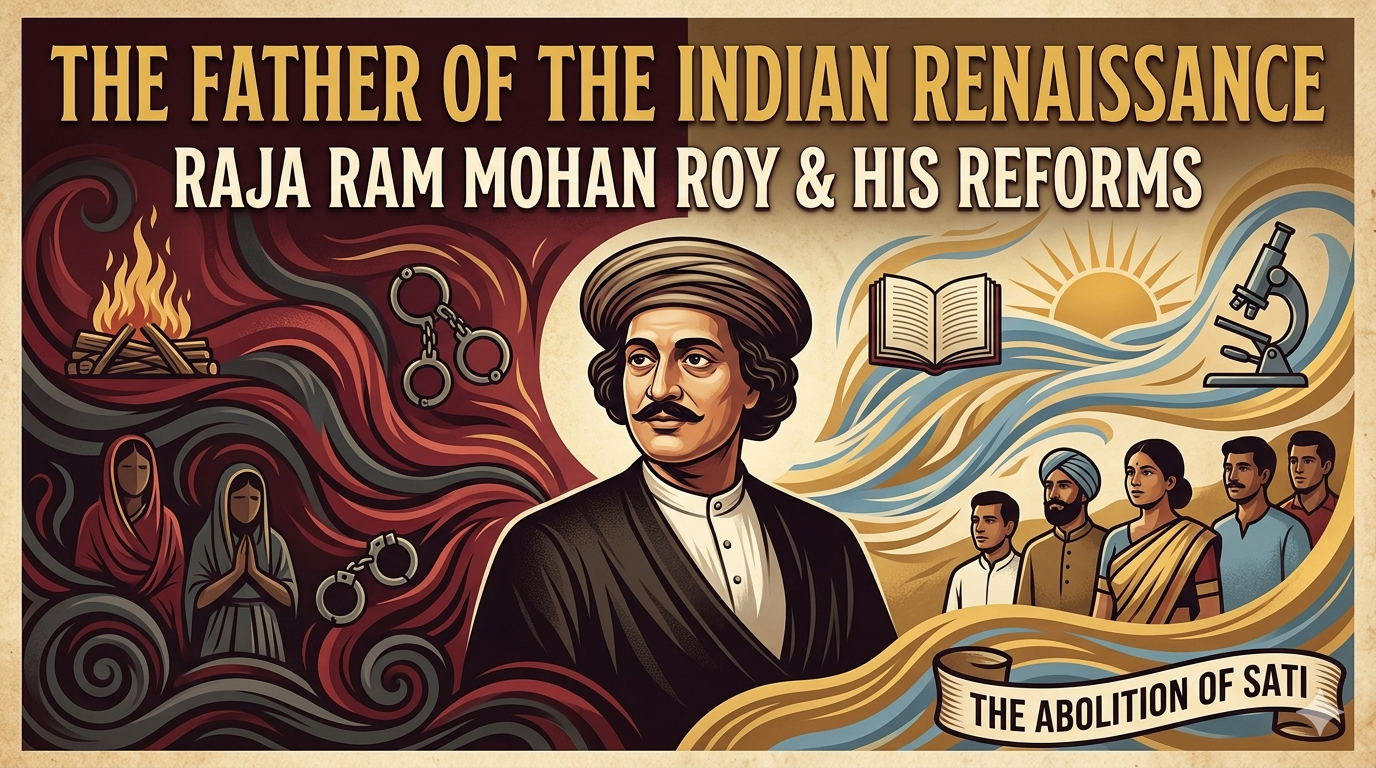
The life of Raja Ram Mohan Roy was a testament to the power of intellectual defiance against traditional stagnation. Born in 1772 in Radhanagar, Bengal, into a conservative Brahmin family, Roy’s early life was marked by an insatiable hunger for linguistic and theological diversity. By the age of fifteen, he had mastered Sanskrit, Persian, and Arabic, later adding English, Greek, and Hebrew to his repertoire. This multilingualism allowed him to bypass biased translations and study the core philosophies of Islam, Christianity, and Hinduism directly. His journey was not merely academic; it was a personal quest to find a universal truth that could liberate his countrymen from the shackles of superstition.
Roy’s internal reforms were rooted in a deep-seated Monotheism. He was deeply influenced by the monotheistic elements of the Upanishads and the egalitarian principles of Islam. In 1803, he published Tuhfat-ul-Muwahhidin (A Gift to Monotheists), a bold treatise that criticized idolatry and the belief in supernatural miracles. He argued that the multiplication of gods and the complexity of rituals were tools used by the priestly class to maintain social control. To institutionalise his vision of a rational society, he established the Atmiya Sabha in 1814, which served as a forum for debating philosophical and social issues.
His life was a constant battle between his reformist zeal and the orthodox society that sought to excommunicate him. Despite being disowned by his family and faced with social boycotts, Roy remained steadfast. He viewed social reform and political liberty as two sides of the same coin. He realized that an India divided by caste and blinded by irrationality could never achieve true self-governance. By advocating for the Remarriage of Widows and the Education of Women, he laid the groundwork for the modern Indian social fabric, proving that a single individual’s conscience could indeed redirect the course of a civilization.
The history of a nation is often a tapestry of silent evolution, but there are moments when a single individual acts as a catalyst, changing the chemical composition of a society’s soul. In the Indian context, that individual was Raja Ram Mohan Roy. Born in 1772, during a period of deep political fragmentation and social stagnation, Roy did not merely live through history—he drafted the blueprint for a new India. Often hailed as the "Father of the Indian Renaissance," his work was the first systematic attempt to reconcile ancient Eastern wisdom with the burgeoning rationalism of the West.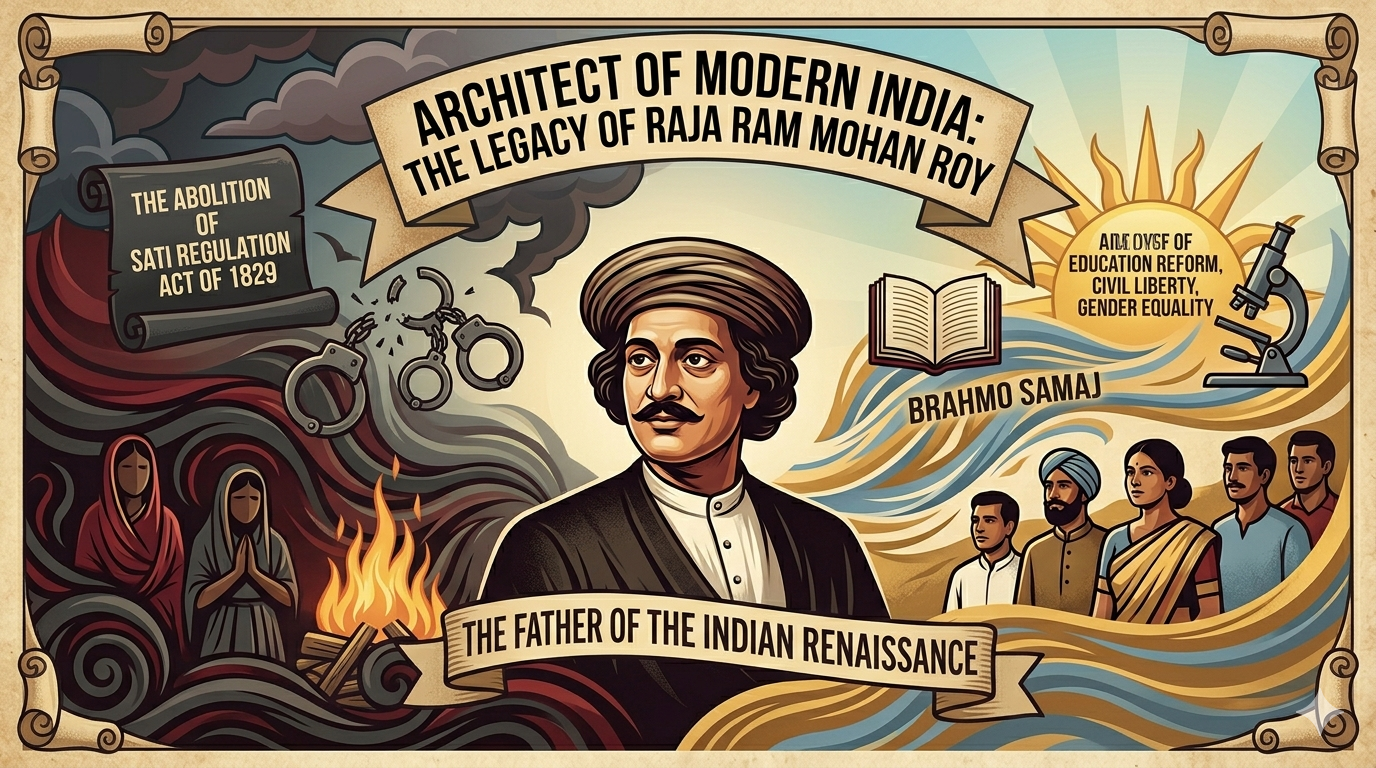
Raja Ram Mohan Roy: The Visionary Who Ignited the Indian Renaissance and Broke the Chains of Medieval Dogma.
The Dawn of the Indian Renaissance
To appreciate why Roy is the "Father" of this movement, one must visualize the landscape of 18th-century India. It was a land paralyzed by what Roy called "the rust of antiquity." Education was confined to rote learning of scriptures, the caste system was an impenetrable wall of social exclusion, and women were relegated to a status lower than domestic property.
The Indian Renaissance was not a sudden burst of art or poetry; it was an intellectual upheaval. Roy argued that India’s decline wasn’t due to its original spiritual roots, but due to the "encrustation" of meaningless rituals and the power of an exploitative priestly class. By mastering Sanskrit, Persian, Arabic, Hebrew, and Greek, Roy went directly to the source texts. He realized that the Upanishads preached a pure, monotheistic philosophy that was entirely compatible with modern scientific thought. This synthesis—the marriage of the Vedantic tradition with Western Liberalism—is what gave birth to the modern Indian identity.
The Abolition of Sati: A Battle for the Soul of a Nation
If there is one singular "system" that Raja Ram Mohan Roy is credited with abolishing, it is the horrific practice of Sati Pratha. This was the custom where a widow was coerced, often drugged or tied down, to be burned alive on her husband's funeral pyre. To the orthodox society of the time, this was a "holy" act of devotion. To Roy, it was "murder disguised as religion."
His crusade against Sati was not just a legal battle; it was a deeply personal one. Having witnessed his own sister-in-law forced into the flames, Roy dedicated his life to ending the practice. He adopted a two-pronged strategy:
The Scriptural Argument: He published pamphlets proving that the ancient Shastras did not mandate Sati, effectively stripping the orthodox clergy of their religious authority.
The Legal Pressure: He lobbied the British administration relentlessly. His efforts culminated in the Sati Regulation Act of 1829, passed by Lord William Bentinck.
By abolishing Sati, Roy broke the spine of medieval patriarchy in India. He asserted that no "tradition," no matter how ancient, could supersede the fundamental Right to Life.
The Pillars of Reform: Principles of the Raja
Roy’s vision for India was built on three non-negotiable principles: Rationalism, Monotheism, and Humanism.
1. Rationalism and Modern Education
Roy was perhaps the first Indian to realize that the British were not just colonial masters, but carriers of a "New Learning." He fought against the establishment of more traditional Sanskrit colleges, famously writing to Lord Amherst that India needed "Mathematics, Natural Philosophy, Chemistry, Anatomy, and other useful sciences." He co-founded the Hindu College in 1817, which became the cradle of the modern Indian intelligentsia.
2. The Brahmo Samaj and Universalism
In 1828, he founded the Brahmo Samaj. This wasn't a new religion but a reformist society. It banned idol worship and animal sacrifice, focusing instead on the "worship of the Eternal, Unsearchable, Immutable Being." This was a direct attack on the caste-based divisions of the time. Roy believed that if Indians could unite under a single, formless God, the barriers of caste and creed would naturally dissolve.
3. Civil Liberties and the Free Press
Long before the Indian National Congress was formed, Roy was fighting for the Freedom of the Press. He launched the Persian newspaper Mirat-ul-Akbar and the Bengali Sambad Kaumudi. He believed that a government is only as good as the feedback it receives from its people. When the British tried to stifle the press with the 1823 Licensing Regulations, Roy was the first to file a legal protest, marking the beginning of the Indian struggle for civil rights.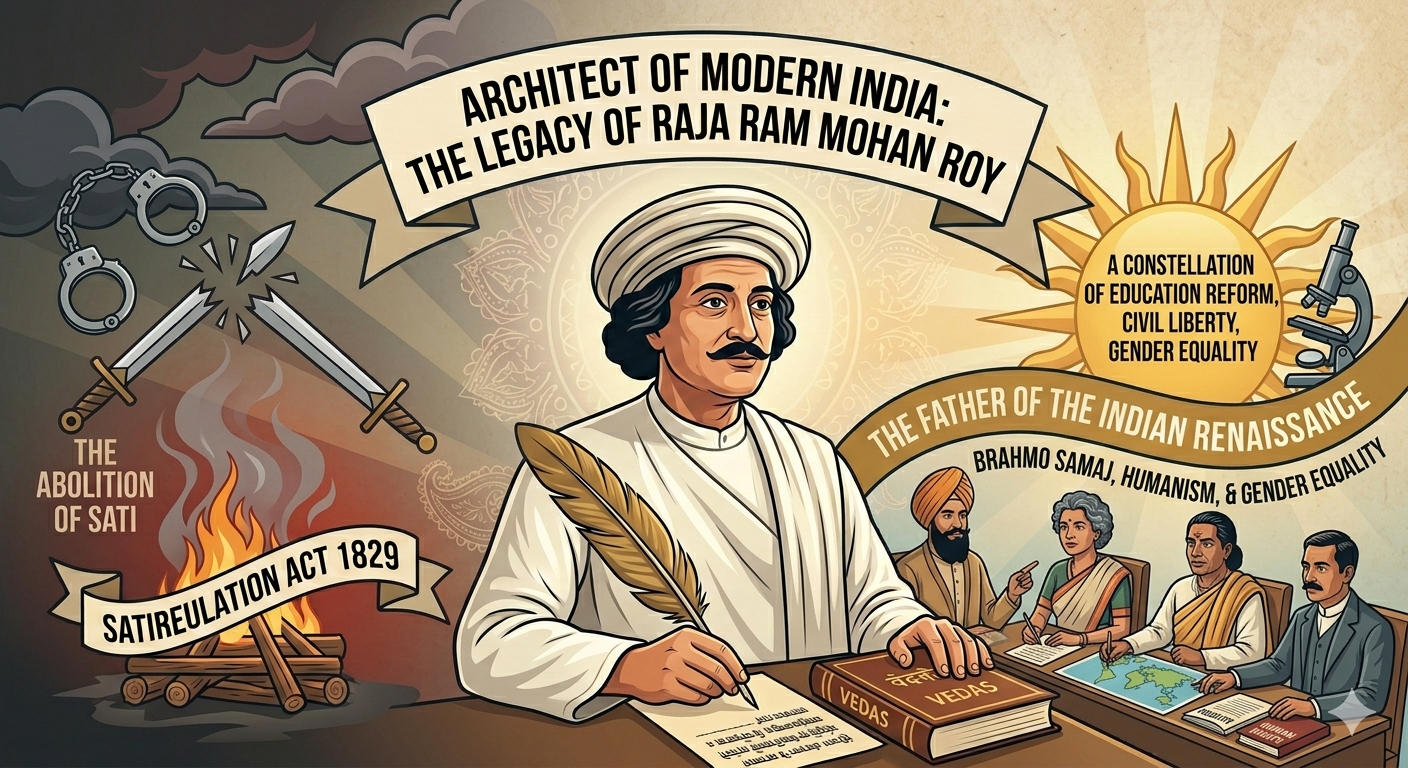
Architect of Modern India" and the "Father of the Indian Renaissance." with other reformers
The Persistence of the Past: Why Roy Matters Today
It is often asked: if Roy abolished these systems two centuries ago, why do we still study him? The truth is that while the "legal" systems like Sati are gone, the "mental" systems of prejudice remain.
The Gender Gap: We no longer burn widows, but the secondary status of women in inheritance, wage gaps, and domestic safety remains a shadow over modern India. Roy’s advocacy for women’s right to property is a battle still being fought in many rural and urban households.
Scientific Temper: In an era of "fake news" and the revival of superstitions, Roy’s emphasis on Reason over Dogma is more vital than ever. He taught us that to be a patriot is to be a critic—to look at one's culture and demand better.
Social Inclusion: The caste hierarchies that Roy challenged with the Brahmo Samaj have morphed into political identities. The "universal brotherhood" he envisioned remains the ultimate goal for a cohesive Indian democracy.
Conclusion: The Eternal Lesson
We need to learn from Raja Ram Mohan Roy not just for his historical achievements, but for his courage to stand alone. He was excommunicated by his family and vilified by his peers, yet he refused to move. He understood that a nation cannot march into the future if half its population (women) is chained to the past and its mind is clouded by irrationality.
Raja Ram Mohan Roy was the first "Modern Man" of India. He taught us that our heritage is a living thing—not a museum to be guarded, but a garden to be weeded. As we navigate the complexities of the 21st century, his life serves as a compass: reminding us that progress is not just about building infrastructure, but about building the human character.