NASA Artemis II launch': The historic Moon Mission 2026
.jpg)
The excitement at NASA's Kennedy Space Center in Florida is electric as the Artemis rocket stands ready on the launch pad. Towering against the Florida sky, the massive Space Launch System, or SLS, with Orion spacecraft perched atop it, signals the imminent NASA Artemis II launch. Set for no earlier than April 1, 2026, at 6:24 p.m. EDT from Launch Complex 39B, this mission represents a pivotal moment in human space exploration. After decades of preparation and the successful uncrewed Artemis I test in 2022, NASA is poised to send humans back toward the Moon for the first time since Apollo 17 in 1972.
As teams make final preparations, the Artemis rocket on launch pad has captured global attention. Engineers, astronauts, and mission controllers work around the clock, with the countdown clock already ticking. Weather forecasts show an 80 percent chance of favorable conditions for launch day, though clouds and winds remain factors to watch. This NASA Artemis II launch is not just another rocket firing into space; it is a bold step forward in the Artemis program, designed to establish sustainable human presence on the Moon and eventually pave the way for Mars missions.
Understanding the NASA Artemis Program
To appreciate the significance of the NASA Artemis II launch, one must first grasp the broader Artemis program. Named after the Greek goddess of the Moon and twin sister of Apollo, Artemis builds directly on the legacy of the Apollo missions while addressing modern challenges. Unlike the race-to-the-Moon urgency of the 1960s, today's Artemis initiative emphasizes collaboration, diversity, and long-term exploration.
The program aims to land the first woman and first person of color on the lunar surface, create a lunar economy, and test technologies for deep-space travel. Artemis II serves as the critical bridge: the first crewed flight of the SLS rocket and Orion spacecraft. Following the uncrewed Artemis I, which successfully orbited the Moon and returned safely, Artemis II will verify that these systems perform flawlessly with humans aboard in the harsh environment of deep space.
NASA officials have repeatedly emphasized readiness. "We are ready," stated mission managers during recent pre-launch briefings, highlighting that the crew, rocket, spacecraft, and ground systems are all aligned for this historic NASA Artemis II endeavor.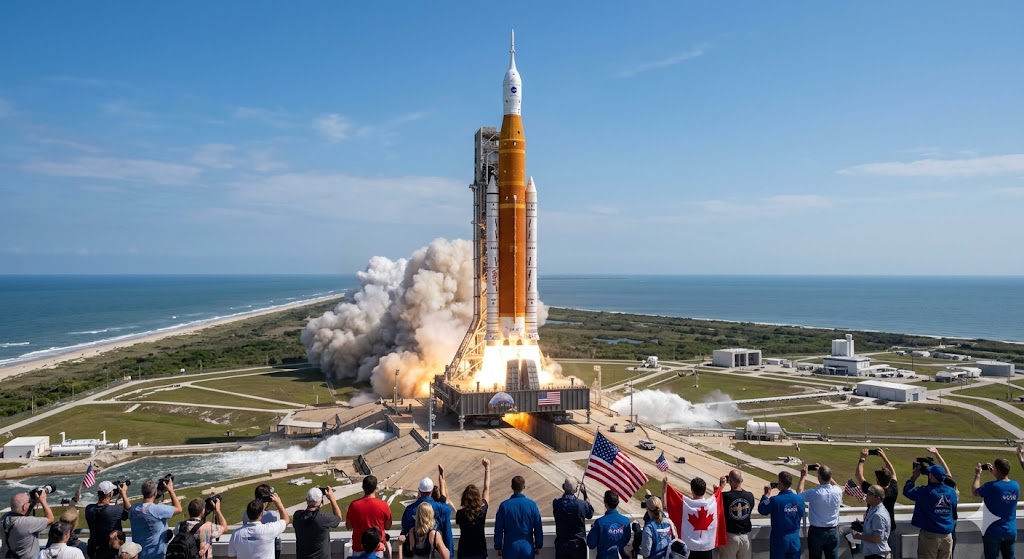
Artemis II: A New Dawn for Lunar Exploration
The SLS Rocket: Engineering Marvel Powering Artemis II
Central to every discussion of the NASA Artemis II launch is the SLS rocket itself. Standing 322 feet tall—taller than the Statue of Liberty—the SLS is NASA's most powerful rocket ever built. It delivers 8.8 million pounds of thrust at liftoff, surpassing even the legendary Saturn V by about 15 percent.
The SLS consists of a core stage powered by four RS-25 engines (veterans from the Space Shuttle program) and two five-segment solid rocket boosters. These boosters provide the initial muscle, burning for about two minutes before separating. The core stage then takes over, propelling the vehicle higher for roughly eight minutes until it too falls away. An interim cryogenic propulsion stage then performs the trans-lunar injection burn, sending Orion on its path to the Moon.
What makes the SLS unique for the Artemis II launch is its ability to send Orion, crew, and future cargo directly toward the Moon in a single launch. Rollout to the launch pad occurred on March 20, 2026, after careful testing and adjustments for earlier technical issues. Now, the Artemis rocket on launch pad gleams under Florida sunlight, its mobile launcher firmly in place at Pad 39B. This SLS rocket Artemis II configuration has undergone rigorous NASA rocket testing, from engine firings to full-system simulations, ensuring every component is flight-ready.
Observers watching NASA rocket live streams or Artemis II launch live coverage will witness a symphony of engineering: engines igniting seven seconds before liftoff, boosters roaring to life at T-zero, and the vehicle clearing the tower in just seconds. It is a breathtaking display of how rockets launch, blending decades of experience with cutting-edge innovation.
Orion Spacecraft: The Crew's Home in Deep Space
Riding atop the SLS during the NASA Artemis II launch is the Orion spacecraft, nicknamed "Integrity" for this mission. Orion is more than a capsule—it is a sophisticated deep-space habitat designed to protect astronauts from radiation, micrometeoroids, and the vacuum of space while providing life support for up to three weeks.
Measuring about 330 cubic feet of habitable volume, Orion features advanced avionics, a European Service Module for propulsion and power, and a heat shield capable of withstanding the fiery 25,000 mph reentry speeds expected upon return. During Artemis II, the crew will test Orion's systems in real-time, including communications, navigation, and emergency procedures.
Meet the Crew of NASA Artemis II
No NASA Artemis II launch would be complete without its remarkable crew. Commander Reid Wiseman, a Navy test pilot and former Chief Astronaut, leads the mission with calm expertise gained from prior spaceflight experience. Pilot Victor Glover, a naval aviator and the first Black astronaut headed to deep space, brings precision piloting skills honed on the International Space Station. Mission Specialist Christina Koch, holder of the record for the longest single spaceflight by a woman, contributes engineering prowess and endurance. Rounding out the international team is Mission Specialist Jeremy Hansen from the Canadian Space Agency, the first Canadian to fly a lunar mission.
These four astronauts embody diversity and excellence. They have trained extensively together, sharing a Moon mascot with the public during recent quarantine activities. Their roles are clearly defined: Wiseman oversees command decisions, Glover handles piloting, and Koch and Hansen manage specialist tasks, including science experiments and spacecraft operations.
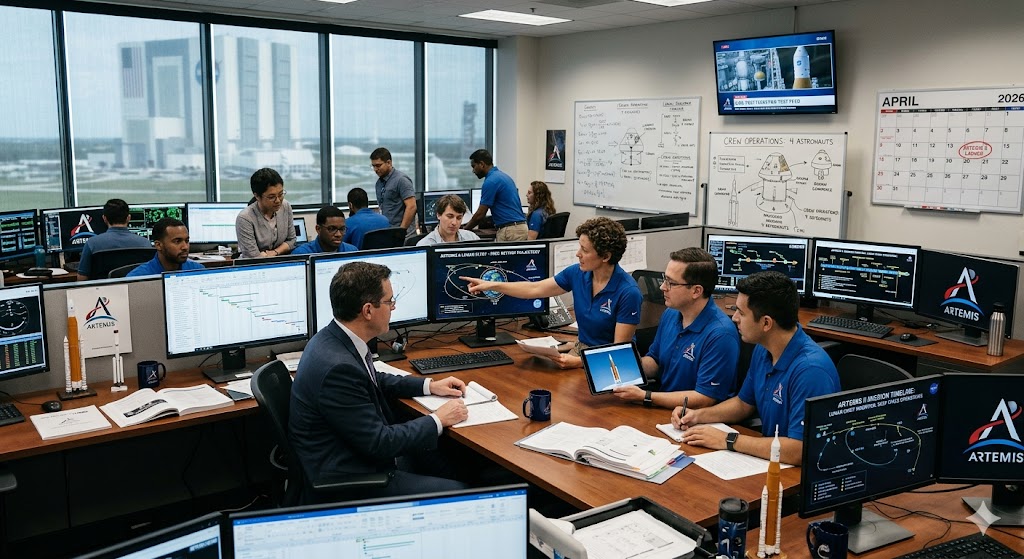
Trajectory Planning: Specialists analyze the "Free Return Trajectory," ensuring the crew can safely loop around the Moon and return to Earth
Artemis II Launch Date and Mission Timeline
The Artemis II launch date remains firm for April 1, 2026, with backup opportunities through April 6. The two-hour launch window opens at 6:24 p.m. EDT. Once underway, the approximately 10-day mission unfolds in carefully choreographed phases.
After liftoff and separation from SLS stages, Orion will perform a series of engine burns to achieve a free-return trajectory around the Moon. The crew will venture farther from Earth than any humans before—potentially surpassing Apollo 13's record of 248,655 miles. At closest lunar approach, they will pass about 4,600 miles from the Moon's surface, offering stunning views of the far side before swinging back toward Earth.
Throughout, the astronauts will conduct tests, communicate with ground control, and even participate in live broadcasts. Reentry will test Orion's heat shield under extreme conditions, followed by splashdown in the Pacific Ocean. NASA Artemis II update briefings will keep the public informed every step of the way.
How Rockets Launch: The Science Behind Artemis II
For those curious about the fundamentals, understanding how rockets launch reveals the precision required for the NASA Artemis II launch. The process begins with cryogenic fueling of liquid hydrogen and oxygen. At T-minus seven seconds, the RS-25 engines ignite sequentially, building thrust while computer systems monitor for anomalies. At T-zero, the solid rocket boosters ignite, generating an explosive roar audible for miles. The vehicle accelerates rapidly, reaching supersonic speeds within seconds and orbital velocity shortly after booster separation.
Safety systems, including abort modes, stand ready throughout. This NASA rocket testing heritage ensures reliability, drawing lessons from decades of Shuttle and Saturn flights. Live NASA launch coverage via NASA+ or official streams will capture every dramatic moment of the Artemis II launch live.
Preparations, Rollout, and Public Engagement
The journey to the Artemis II launch pad was meticulous. The rocket rolled out from the Vehicle Assembly Building on March 20 after earlier weather-related holds, covering four miles at a stately 0.82 mph. Teams conducted integrated tests, loaded propellants during simulations, and verified ground systems. Crew arrival at the launch site added a personal touch, with astronauts sharing moments from quarantine.
Public interest is soaring. NASA encourages viewers to tune into NASA Artemis II live streams, virtual Q&As, and educational resources explaining NASA rocket rollout and mission science. Schools, space enthusiasts, and families worldwide will gather to watch this milestone.
The Broader Impact and Future of Artemis
The NASA Artemis II launch transcends a single flight. It tests life-support systems, validates deep-space navigation, and gathers data for future lunar landings under Artemis III and beyond. By proving Orion's crew-rated capabilities, it accelerates plans for a lunar Gateway station, sustainable habitats, and eventual crewed Mars voyages.
International partners like the Canadian Space Agency underscore Artemis's collaborative spirit. As NASA astronauts Artemis II prepare to fly farther than ever, they inspire a new generation to dream of stars.
Challenges remain—technical hurdles delayed earlier windows—but the team's resilience shines through. With the SLS rocket Artemis II now firmly on the pad and countdown underway, anticipation builds for what promises to be a flawless NASA launch.
In the days ahead, as the world watches NASA Artemis II update feeds and Artemis II launch live broadcasts, one truth emerges: humanity stands on the cusp of a new era in space. The Artemis rocket on launch pad is more than metal and fuel; it is a beacon of innovation, courage, and the unyielding human drive to explore.
Whether following along via NASA rocket live coverage or reflecting on the program's legacy, the Artemis II launch date will be remembered as the moment we truly began our return to the Moon. This NASA Artemis program milestone reaffirms that the stars are within reach when science, teamwork, and vision align.