"US-Israel-Iran War Day 32: Key Updates & Outlook"

Day 32 Iran War : As the US-Israel-Iran war enters its 32nd day on April 1, 2026, the conflict that began with surprise joint airstrikes on February 28 continues to reshape the Middle East and ripple across the global stage. What started as a targeted campaign to dismantle Iran’s nuclear ambitions and military infrastructure has evolved into a protracted confrontation marked by relentless aerial operations, Iranian missile retaliation, and severe economic fallout. President Donald Trump’s recent signals that US military involvement could wind down in two to three weeks—whether or not a formal deal is reached or the Strait of Hormuz fully reopens—have injected cautious optimism into markets while underscoring the war’s high stakes.
This article provides a comprehensive, structured overview of the recent updates in the US-Israel-Iran war, drawing on verified developments from the first four weeks and the latest events on day 32. It examines military progress, political rhetoric from key leaders including Trump and Netanyahu, economic and infrastructural reactions worldwide, international responses (with particular attention to Russia and Iran’s positions), and the humanitarian toll. Written for clarity and depth, it offers readers a professional analysis suitable for immediate publication.
Background: Roots of the US-Israel-Iran War
The US-Israel-Iran war of 2026 did not erupt in isolation. It stems from decades of escalating tensions rooted in Iran’s nuclear program, ballistic missile development, and support for regional proxies. Following the 1979 Islamic Revolution and the US withdrawal from the 2015 Joint Comprehensive Plan of Action (JCPOA) in 2018, Iran accelerated uranium enrichment while facing crippling sanctions. Israel viewed Tehran’s advances as an existential threat, conducting covert operations and airstrikes on Iranian assets.
By late 2025, domestic unrest in Iran—fueled by economic collapse and protests that claimed thousands of lives—weakened the regime. Trump’s return to the White House amplified calls for “maximum pressure.” Indirect nuclear talks in February 2026 showed brief promise but collapsed amid intelligence reports of Iranian leadership gatherings. On February 28, 2026, US and Israeli forces launched Operation Epic Fury and Operation Roaring Lion, delivering nearly 900 strikes in 12 hours. The assassinations of Supreme Leader Ali Khamenei, security chief Ali Larijani, and other top officials marked the opening salvo.
Iran retaliated with Operation True Promise IV, unleashing over 1,200 ballistic missiles and 2,300 drones at Israeli cities and US bases across the Gulf. Tehran also seized effective control of the Strait of Hormuz—through which 20 percent of global oil passes—imposing tolls in Chinese yuan and disrupting energy flows. The war quickly drew in proxies: Hezbollah escalated fighting in Lebanon, and Houthi forces joined attacks on Israel by late March.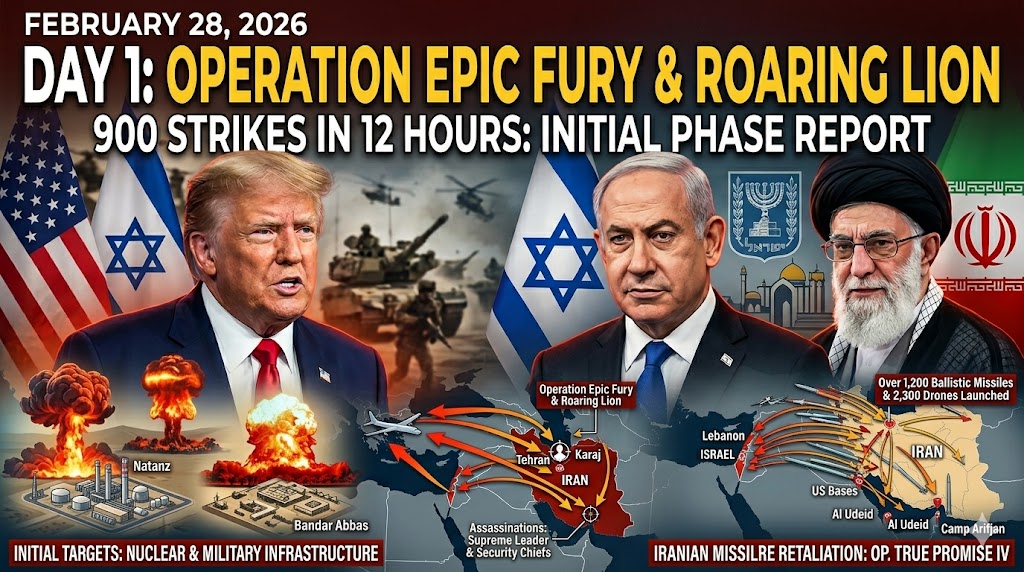
The Triad of Leadership: Features Donald Trump, Benjamin Netanyahu, and the new Iranian leadership, symbolizing the political tug-of-war and the recent "two-to-three week" exit strategy signals from the White House.
Timeline: The First Four Weeks of Intense Conflict
Week 1 (Feb 28–March 6): The opening phase stunned the region. US and Israeli strikes hit over 500 targets, including nuclear sites at Natanz and Fordow, military bases, and leadership compounds. Civilian casualties mounted rapidly, with a girls’ school near Bandar Abbas struck, killing more than 170. Iran’s missile barrages damaged US facilities in Kuwait and Bahrain, killing six American soldiers in one incident. Hezbollah violated ceasefires, prompting Israeli ground operations in southern Lebanon. Oil prices surged past $90 per barrel.
Week 2 (March 7–13): Focus shifted to energy infrastructure. US-Israeli raids targeted oil depots and the South Pars gas field, causing environmental damage described as “black rain.” Iran hit Qatari LNG facilities, slashing output by 17 percent for years. Mojtaba Khamenei was elected Iran’s new Supreme Leader, defying Trump’s public rejection of him as a successor. Civilian sites in Iran suffered extensive damage, with nearly 10,000 structures affected.
Week 3 (March 14–20): Assassinations continued, with Larijani and other IRGC figures killed. Iranian missiles reached Dimona in Israel, exposing gaps in defenses. Trump publicly distanced himself from certain Israeli strikes on gas fields while threatening to “obliterate” Iranian power plants if Hormuz remained closed. Humanitarian numbers worsened: over 1,400 children reported killed in Iran alone.
Week 4 (March 21–27): Trump issued ultimatums on Hormuz reopening, later extending deadlines. US troop deployments to the Middle East swelled by thousands. Israel expanded operations in Lebanon toward the Litani River. Houthi involvement added a southern front. By the end of this period, Iran’s death toll exceeded 1,900, with global oil prices peaking above $112 per barrel.
Throughout these weeks, the US-Israel-Iran war demonstrated remarkable asymmetry: superior Western airpower versus Iran’s resilient missile and proxy strategy.
Day 32 Updates: Military Situation as of April 1, 2026
On day 32, US and Israeli strikes persist across Iran, targeting steel plants in Isfahan and pharmaceutical facilities. Explosions rocked Tehran and Esfahan overnight, with reports of civilian deaths in Mahallat and Zanjan. Iran launched additional missiles, causing a large fire at Kuwait International Airport and damaging a tanker off Qatar. A Kuwaiti tanker was also hit in regional waters.
US casualties stand at 15 killed and 348 wounded, with 17 bases damaged. Israel reports 11 soldiers and 23 civilians killed, plus over 6,000 injured. Iranian figures vary: official counts cite around 2,000 dead and 26,000 injured, while independent estimates are higher. Hezbollah operations in Lebanon have killed over 1,100, displacing more than 1.2 million.
No full-scale ground invasion of Iran has occurred, but US naval assets—including three carrier strike groups—maintain pressure on Hormuz shipping lanes. Iranian control of the strait continues, though partial US escorts have allowed limited oil movements.
Political Developments: Trump’s Rhetoric and Netanyahu’s Stance
President Trump has dominated headlines with pragmatic yet firm messaging. In recent days, he stated the US “will be leaving very soon” and could conclude major operations in “two to three weeks,” even without a nuclear deal or full Hormuz reopening. He shifted responsibility for the strait to oil-dependent nations, telling European allies to “go get your own oil” and criticizing them for insufficient support. A prime-time address is planned for April 1 evening.
Netanyahu has maintained a hard line, emphasizing the destruction of Iran’s nuclear and missile programs. Israeli strikes on Isfahan steel facilities on day 32 underscore continued commitment. However, coordination with Washington shows signs of strain over Lebanon’s proposed new borders.
Iran’s new leadership under Mojtaba Khamenei remains defiant, insisting on no negotiations while Hormuz tolls and proxy attacks continue. Foreign Minister Araghchi acknowledged receiving US messages but denied active talks.
Economic and Infrastructural Reactions to the War
The US-Israel-Iran war has triggered the most significant energy shock since 1973. Global oil prices, after spiking to nearly $120 per barrel, stabilized around $100–$110, still 40–50 percent above pre-war levels. The Strait of Hormuz closure and Qatari LNG disruptions have caused fuel rationing in Asia and airline fee hikes, such as JetBlue’s $9 increase for checked bags.
Infrastructure damage extends beyond energy. Strikes have crippled Iranian power stations, water reservoirs, and data centers, leading to blackouts and internet outages affecting up to 99 percent connectivity at peaks. Aviation has suffered: Dubai airport operations curtailed, regional flights rerouted, and insurance premiums for Gulf shipping skyrocketed.
Road and rail networks in the region face indirect pressure. While no major railway sabotage has been widely reported, supply-chain disruptions from port delays and fuel shortages have slowed freight movement across Turkey, Iraq, and Gulf states. European importers report delays in goods transit via overland routes bypassing the Red Sea and Hormuz. Global GDP growth forecasts have been trimmed by 0.3 percent, with Europe facing a potential 1 percent drag due to energy import costs.
Markets reacted with volatility: Asian stocks rebounded on Trump’s end-war signals, but US consumer inflation fears persist amid gasoline prices exceeding $4 per gallon in many states. Iran’s economy, already sanctioned, has seen hyperinflation and the issuance of a 10-million-rial banknote.
Russia has condemned the US-Israel-Iran war as “destabilizing” but shown no appetite for direct intervention, focusing instead on diplomatic statements. Iran continues leveraging its remaining alliances for political cover while prioritizing regime survival.
International Reactions and Broader Geopolitical Shifts
Russia’s measured response—verbal criticism without military aid—reflects its own strategic calculations amid Ukraine commitments. China has remained largely silent beyond urging restraint, while continuing yuan-denominated oil transactions via Hormuz. Gulf states, initially neutral, have suffered collateral damage and quietly supported US efforts to secure shipping lanes. European nations face Trump’s ire for limited assistance, prompting NATO intercepts of Iranian drones over Turkey.
Syria’s leadership has pledged non-involvement unless directly attacked, citing war fatigue. Oman expressed regret over collapsed pre-war talks. The broader international community questions the legal basis of the initial strikes, though few call for immediate ceasefire given Iran’s proxy escalations.
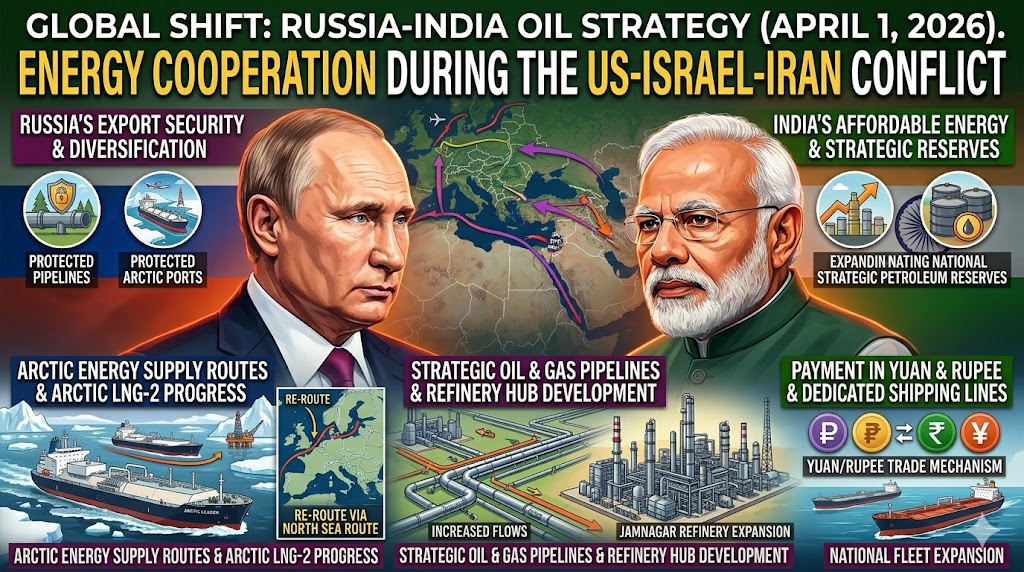
Russia’s Renewed Leverage: With 20% of global oil and gas stranded in the Gulf, Russia has emerged as the primary alternative supplier. Moscow is leveraging the crisis to maximize energy rents, with crude prices hitting nearly $110 per barrel, providing a massive windfall for its National Wealth Fund.
Humanitarian Impact and Civilian Toll
The human cost of the US-Israel-Iran war is staggering. In Iran, strikes on civilian infrastructure—including hospitals, schools, and residential areas—have killed thousands, with children disproportionately affected. Lebanon’s displacement crisis risks famine and disease outbreaks. In Israel, missile debris and cluster munitions have injured thousands despite advanced defenses. Gulf states report dozens of civilian deaths from Iranian strikes on airports and energy sites.
UN agencies warn of a looming humanitarian catastrophe, with aid crossings restricted and medical supplies scarce due to damaged pharmaceutical plants in Iran.
Outlook: Path to De-escalation or Prolonged Conflict?
Trump’s day-32 declarations suggest a desire for swift conclusion, focusing on degrading Iran’s capabilities rather than regime change. If operations taper in the coming weeks, diplomatic channels—possibly via Qatar or Oman—could reopen. However, Iran’s hardened stance and proxy networks may prolong low-level hostilities.
For the US-Israel-Iran war to truly end, verifiable dismantling of nuclear and missile programs, Hormuz reopening, and proxy ceasefires will be essential. Markets will watch Trump’s evening address closely for concrete timelines.
Conclusion
Day 32 of the US-Israel-Iran war finds the region in flux: military pressure unrelenting, economic pain widespread, and political signals pointing toward possible wind-down. The conflict has already altered energy markets, displaced millions, and tested alliances. As Trump hints at an exit in two to three weeks, the world holds its breath—hoping for resolution without further escalation. Ongoing monitoring of developments remains critical for governments, businesses, and citizens alike.