Shroud of Turin DNA: The Mystery of the Indian Connection
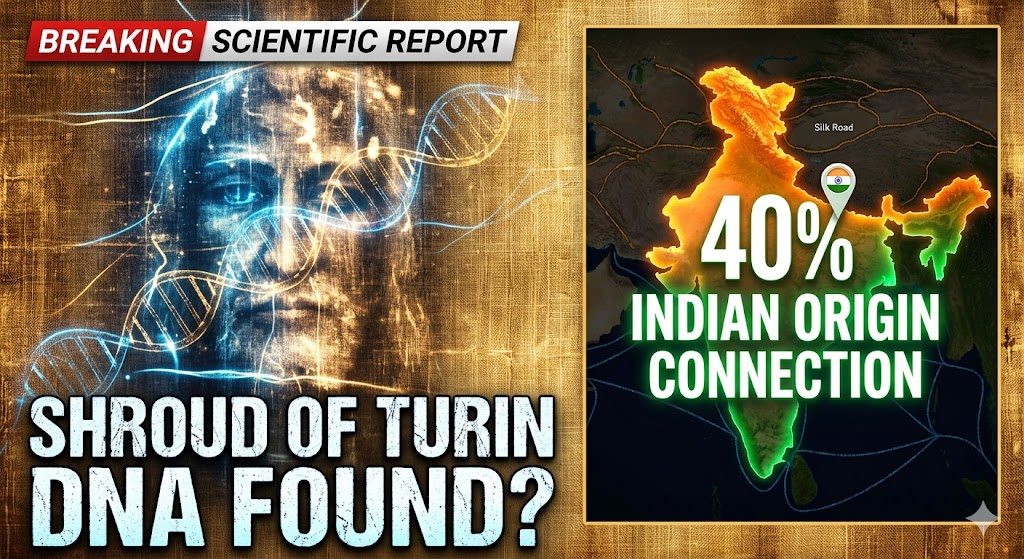
The Shroud of Turin stands as the most scrutinized, debated, and enigmatic archaeological artifact in human history:
To comprehend the true weight of the Shroud of Turin, one must look beyond the physical linen to the spiritual "why" of its existence. The story of Christianity does not begin at the cross, but in a garden. According to the Book of Genesis, Adam and Eve were the first humans, created in a state of "original justice"—a life without death, suffering, or shame. However, the biblical narrative describes their succumbence to temptation, eating the forbidden fruit from the Tree of Knowledge. This act, known as "The Fall," introduced sin and mortality into the human experience. In Christian theology, the disobedience of Adam and Eve created a debt that humanity could not pay. For millennia, the biblical narrative follows a lineage seeking a way back to the Divine. This is where the story of Jesus Christ enters. St. Paul, in his writings, refers to Jesus as the "Last Adam" or the "New Adam." The logic is a mirror image: through the first Adam’s disobedience, death entered the world, but through the New Adam’s perfect obedience and sacrifice on Good Friday, the "Original Sin" was reconciled, and the path to eternal life was restored. The shroud of Turin face of Jesus is believed by many to be the literal image of this "New Adam" at the moment he conquered the death that began in Eden.
The life of Jesus Christ serves as the bridge between ancient prophecy and modern faith. Born in Bethlehem and raised in Nazareth, Jesus’ three-year ministry focused on radical love, healing the sick, and challenging the rigid religious and political structures of the Roman-occupied Levant. One of the most intriguing aspects of the shroud of Turin issue is how it interacts with the "Lost Years of Jesus"—the period between his childhood and the start of his ministry at age 30. A persistent historical theory suggests that Jesus in India was a reality, with Jesus traveling along the Silk Road to study under Buddhist and Hindu masters. While mainstream Christianity does not include these accounts in the Bible, the discovery of Indian DNA on the Shroud of Turin has reignited these discussions. Whether Jesus physically walked the soil of India or if the cloth itself merely passed through Indian trade routes, the shroud of Turin Indian DNA markers prove a tangible connection between the relic and the East.
In a landmark study, researchers analyzed mitochondrial DNA (mtDNA) extracted from dust particles vacuumed from the Shroud. The results were a genetic map of the world. While researchers expected the DNA to be strictly Mediterranean or Middle Eastern, the results were far more diverse. A significant portion of the DNA sequences—estimated by some researchers as up to 40% of the plant and human DNA traces—pointed directly to the Indian subcontinent. Researchers identified haplogroups typical of South Asia, suggesting that the linen may have been manufactured in India, which was the world leader in high-quality textiles like flax and linen in antiquity. The DNA also showed traces from the Middle East, North Africa, China, and the Caucasus, suggesting the cloth was handled by people from across the globe throughout its history. There are several professional explanations for the shroud of Turin DNA Indian markers. Ancient India was renowned for its weaving, and the cloth could have been an export to the Roman Empire. Furthermore, history records the Shroud moving from Jerusalem to Turkey, then to France and Italy; during these centuries, it was touched by thousands of pilgrims from the East. Additionally, tradition holds that St. Thomas traveled to India to spread the faith, making it possible that early Christian artifacts were exchanged between these regions.
The Shroud of Turin is intrinsically linked to Good Friday, the day Jesus was crucified. In Christianity, Good Friday is the day of mourning and deep reflection. It commemorates the crucifixion of Jesus Christ at Calvary. Despite the grim nature of the event, it is called "Good" because it represents the moment Christians believe the price for human sin was paid in full. The Turin Shroud is often called the "Fifth Gospel" because it provides a graphic, anatomical account of the events of Good Friday. The cloth shows over 100 whip marks consistent with a Roman flagrum, and bloodstains on the head suggest a cap of thorns was forced onto the scalp. A large bloodstain on the side matches the biblical account of a Roman spear piercing Jesus’ heart to confirm death. Most notably, the nail wounds are through the wrists, which was anatomically necessary to support a body’s weight—a detail medieval forgers would likely have missed, as they usually depicted nails through the palms.
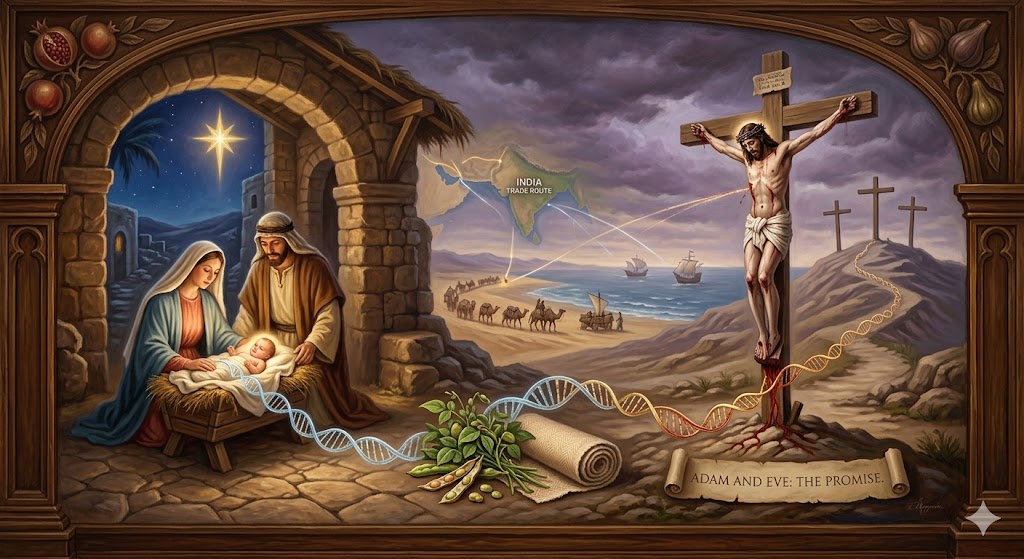
From the Fall of Adam and Eve to the Birth and Sacrifice of Jesus Christ—the story of Christianity is a global journey. New research into the Shroud of Turin’s Indian DNA markers suggests that the "New Adam" has always had a connection to the East
The debate over the shroud of Turin real or fake status remains a tug-of-war between carbon dating and forensic science. In 1988, three laboratories dated the Shroud to the 13th or 14th century, but this study has been widely criticized by the shroud of Turin research community. Many argue the sample was taken from a corner that had been repaired by medieval nuns using "invisible reweaving," or that the cloth was contaminated by carbon-heavy smoke from historical church fires. If it is a fake, no one has been able to explain how it was created. There are no pigments, oils, or chemicals found in the image area. The image is a "negative" that contains 3D topographical information and exists only on the ultra-thin top layer of the linen fibers, a feat that cannot be replicated even with modern laser technology.
The interest in the Shroud is particularly high in India. Search terms like shroud of Turin explained in Tamil and shroud of Turin in Hindi show a massive digital footprint. The Indian Christian community, one of the oldest in the world, sees the shroud of Turin Indian connection as a validation of their ancient roots and the global nature of the faith. Whether the Shroud of Turin is the literal burial cloth of the "New Adam" or a profound historical puzzle that traveled the Silk Road, it remains a powerful symbol of the sacrifice made on Good Friday. The discovery of Indian DNA on the Jesus shroud reminds us that the story of Jesus Christ, Adam and Eve, and the promise of Christianity is a shared human journey that knows no borders. As we look upon the shroud of Turin face of Jesus, we see not just a man, but a mystery that spans from the gardens of Eden to the ancient looms of India, and finally to the hearts of believers today.
Extended Analysis of South Asian Textiles and the Shroud
To understand the shroud of Turin indian dna, one must look at the textile history of the first century. During the Roman era, India was the epicenter of the global textile trade. The Roman historian Pliny the Elder famously complained about the amount of gold leaving the Roman Empire to purchase Indian fabrics. The "Herringbone" weave found on the Shroud is a complex pattern that suggests a high-quality loom, common in the workshops of ancient India. This provides a scientific basis for the 40% indian dna in shroud of turin findings, as the DNA of the weavers and the plant matter from the region would inevitably be trapped in the fibers during production.
The Role of Good Friday in Modern Theology
The connection between jesus shroud of turin and good friday is best understood through the lens of modern liturgy. Every year, millions of Christians participate in the "Veneration of the Cross." For many, the Shroud provides a visual focal point for this devotion. It is not merely an object of curiosity; it is a spiritual tool that bridges the gap between 2,000 years of history and the present moment. The shroud of turin issue regarding its authenticity often fades in the presence of its ability to inspire faith and reflection on the nature of suffering and redemption.
Scientific Advancements in Shroud Research
As we move further into the 21st century, new technologies like Wide-Angle X-ray Scattering (WAXS) are being used to supplement shroud of turin research india dna. These methods allow scientists to date the natural aging of the flax cellulose. Recent results from Italian researchers suggest that the linen fibers are indeed approximately 2,000 years old, aligning with the time of Jesus rather than the medieval period suggested by the 1988 carbon dating. This makes the shroud of turin indian dna even more significant, as it places the Indian connection at the very origin of the relic.
Theological Symbolism: Adam and Eve to Jesus Christ
The symbolic link between the first humans and the figure on the Shroud is central to Christianity. In traditional iconography, the skull of Adam is often depicted at the base of the cross of Jesus. This signifies that the blood of Christ flows down to wash away the original sin of Adam and Eve. The Shroud of Turin serves as the physical manifestation of this theological bridge. By examining the shroud of turin face of jesus, believers see the resolution of the conflict started in Genesis.
Historical Timeline and the Silk Road Connection
The movement of the Shroud from Jerusalem to Turin is a journey across continents. Historical records and pollen analysis suggest a path through Edessa (modern-day Turkey), Constantinople, and eventually Europe. However, the presence of indian dna shroud of turin suggests a secondary layer of movement. During the first few centuries AD, the trade routes between the Roman Empire and the Kushan Empire in India were bustling. It is scientifically plausible that the raw materials or the finished textile originated in the East before being used in the tomb of Joseph of Arimathea.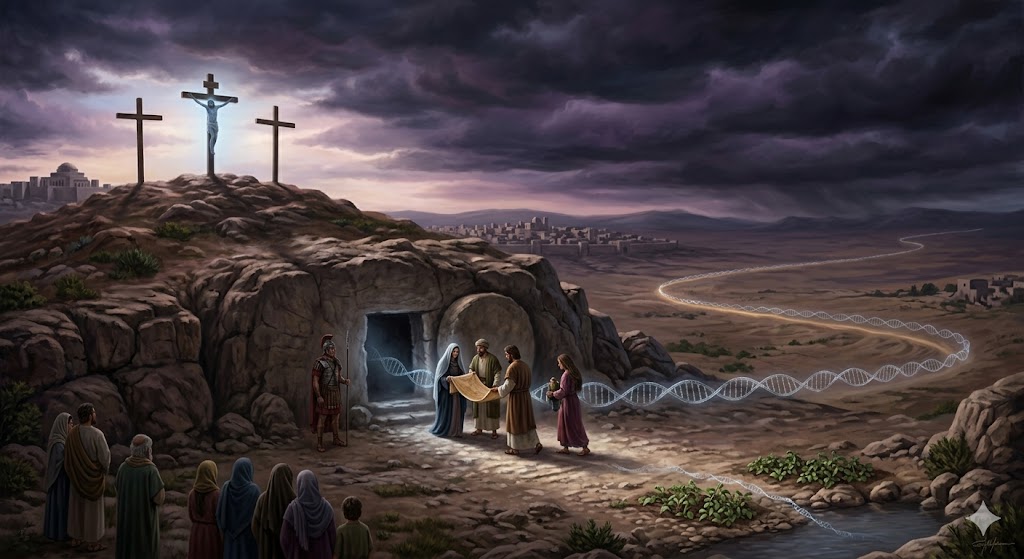
image captures the solemn, transformative moment of Good Friday as described . It blends the historical context of the crucifixion with the unique biological links identified in the Shroud's DNA. The empty crosses, the pale, negative-light figure of Jesus in the tomb, and the faint double-helix trails extending towards the East symbolize the global connection . Small details, such as the cowpea plants (Vigna unguiculata), are subtly integrated to reflect the scientific findings.
Cultural Significance in India
Today, the shroud of turin indian connection is a point of pride for many in the South Asian Christian community. With over 28 million Christians in India, the relic provides a historical anchor. Translations such as shroud of turin explained in tamil and shroud of turin in hindi allow local communities to engage with the scientific data. It reinforces the idea that Jesus Christ is not a figure confined to Western history, but one whose life and death had immediate and physical ties to the East.
Conclusion
In summary, the Shroud of Turin remains a multifaceted mystery. It is a biological record of the world’s ancient trade routes, a forensic record of a Roman execution, and a theological record of the core tenets of Christianity. From the ancient story of Adam and Eve to the modern genetic discoveries of indian dna shroud of turin, the cloth continues to speak to a global audience, transcending language and culture. As research continues, the shroud of turin issue will likely remain at the forefront of the intersection between science and faith.